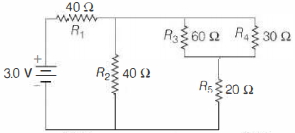
In the circuit shown below, the resistances are given (in $\Omega$ ) and the battery is assumed ideal with emf equal to $3.0 \,V$. The resistor that dissipates the most power is
KVPY 2011, Medium
Download our app for free and get started
(a)
Given circuit is
Above circuit can be reduced to following equivalent circuit.
So, power dissipation is maximum in $40 \,\Omega$ resistor marked $A$ as current through it is maximum.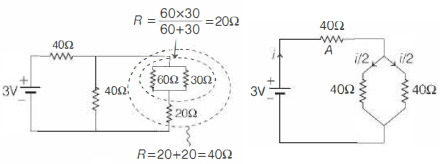

Download our appand get started for free
Experience the future of education. Simply download our apps or reach out to us for more information. Let's shape the future of learning together!No signup needed.*
Similar Questions
- 1One $kg$ of water, at $20\,^oC$, is heated in an electric kettle whose heating element has a mean (temperature averaged) resistance of $20\, \Omega $. The rms voltage in the mains is $200\, V$. Ignoring heat loss from the kettle, time taken for water to evaporate fully, is close to.......... $\min$ [Specific heat of water $= 4200\, J/kg\, ^oC$), Latent heat of water $= 2260\, k\,J/kg$]View Solution
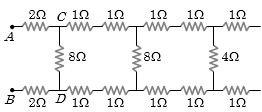
- 2In the figure shown, the total resistance between $A$ and $B$ is ............. $\Omega$View Solution
- 3The electromotive force of a primary cell is $2\, volts$. When it is short-circuited it gives a current of $4$ amperes. Its internal resistance in $ohms$ isView Solution
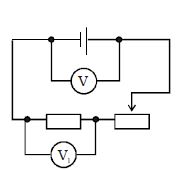
- 4If the rheostat slider were to move from the extreme right to the far left, How will the reading of voltmeter $V_1$ change?View Solution
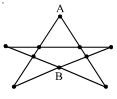
- 5The resistance of all the wires between any two adjacent dots is $R$. Then equivalent resistance between $A$ and $B$ as shown in figure is :View Solution
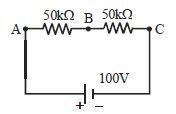
- 6In the adjacent shown circuit, a voltmeter of internal resistance $R$, when connected across $B$ and $C$ reads $\frac{{100}}{3}\,V$. Neglecting the internal resistance of the battery, the value of $R$ is ................. $k \Omega$View Solution
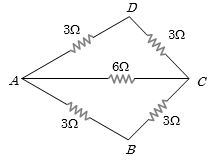
- 7The effective resistance between the points $A$ and $B$ in the figure is ............. $\Omega$View Solution
- 8View SolutionAn energy source will supply a constant current into the load if its internal resistance is
- 9The resistance of a bulb filmanet is $100\,\Omega$ at a temperature of $100\,^o C$. If its temperature coefficient of resistance be $0.005$ per $^o C$, its resistance will become $200\,\Omega$ at a temperature of ................ $^oC$View Solution
- 10In the given figure the ratio of current in $8\,\Omega $ and $3\,\Omega $ will beView Solution