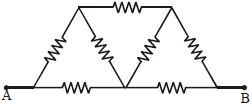
In the circuit shown in the figure below, which of the following statement is incorrect ?
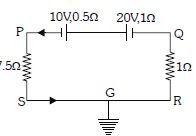
Medium
Download our app for free and get started
The equivalent circuit can be drawn :
$\mathrm{V}_{\mathrm{p}}=7 \mathrm{\,V}$
$\mathrm{V}_{\mathrm{q}}=-1 \mathrm{\,V}$
$\mathrm{V}_{\mathrm{S}}=\mathrm{V}_{\mathrm{R}}=0 \mathrm{\,V}$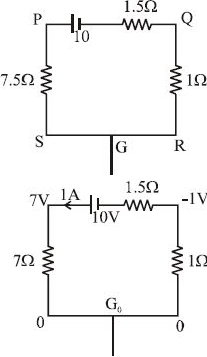

Download our appand get started for free
Experience the future of education. Simply download our apps or reach out to us for more information. Let's shape the future of learning together!No signup needed.*
Similar Questions
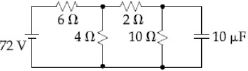
- 1Determine the charge on the capacitor in the following circuit ................ $\mu C$View Solution
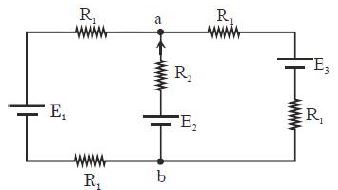
- 2For the circuit shown, with ${R_1} = 1.0\,\Omega $, ${R_2} = 2.0\,\Omega $, ${E_1} = 2\,V$ and ${E_2} = {E_3} = 4\,V$, the potential difference between the points $‘a’$ and $‘b’$ is approximately (in $V$)View Solution
- 3Temperature coefficient at $0\,^oC$ is $0.00125\,^oC^{-1}$. At a temperature of $25\,^oC$ its resistance is $1\,\Omega $. Find the temperature at which resistance is $1.2\,\Omega $View Solution
- 4$E$ denotes electric field in a uniform conductor, $I$ corresponding current through it, ${v_d}$ drift velocity of electrons and $P$ denotes thermal power produced in the conductor, then which of the following graph is incorrectView Solution
- 5If you are provided three resistances $2 \,\Omega$, $3 \,\Omega$ and $6 \,\Omega$. How will you connect them so as to obtain the equivalent resistance of $4 \,\Omega$View Solution
- 6The current flowing through a conductor connected across a source is $2\,A$ and $1.2\,A$ at $0^{\circ}\,C$ and $100^{\circ}\,C$ respectively. The current flowing through the conductor at $50^{\circ}\,C$ will be $......\times 10^2\,mA$.View Solution
- 7The heat produced by a $100\, watt$ heater in $2$ minute will be equal toView Solution
- 8A current $I$ flows through a uniform wire of diameter $d,$ when the mean drift velocity is $v_d.$ The same current will flow through a wire of diameter $d/2$ made of the same material, if the mean drift velocity of the electrons isView Solution
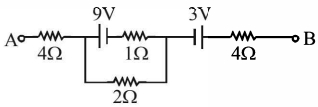
- 9In the circuit shown in figure potential difference between points A and $B$ is $16\,V$. the current passing through $2 \Omega$ resistance will be $...........\,A$View Solution
- 10In the network shown in the following figure, each resistance is $1\,ohm.$ The effective resistance between $A$ and $B$ isView Solution