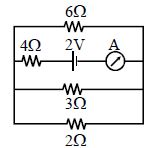
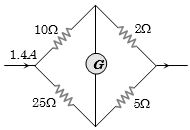
In the circuit shown in the figure, the current flowing in $2\,\Omega $ resistance ............... $A$
Medium
Download our app for free and get started
Current through $2\, \Omega $ $ = 1.4\left\{ {\frac{{(25 + 5)}}{{(10 + 2) + (25 + 5)}}} \right\} = 1\,A$

Download our appand get started for free
Experience the future of education. Simply download our apps or reach out to us for more information. Let's shape the future of learning together!No signup needed.*
Similar Questions
- 1Two cities are $150\,\, km$ apart. Electric power is sent from one city to another city through copper wires. The fall of potential per $km$ is $8\,\, volt$ and the average resistance per km is $0.5 \,\,\Omega .$ The power loss in the wire isView Solution
- 2A meta sample carrying a current along $x-$ axis with density $J$ is subjected to a magnetic field $B$ (along $z-$ axis). The electric field $E$ developed along $y-$ axis is directly proportional to $J$ as well as $B$. The constant of proportionality has $SI\ unit$View Solution
- 3$(1)$ The product of a volt and a coulomb is a joule.View Solution
$(2)$ The product of a volt and an ampere is a joule/second.
$(3)$ The product of volt and watt is horse power.
$(4)$ Watt-hour can be measured in terms of electron volt.
State if
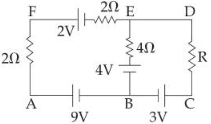
- 4In the electric network shown, when no current flows through the $4\, \Omega $ resistor in the arm $EB$, the potential difference between the points $A$ and $D$ will be ............... $V$View Solution
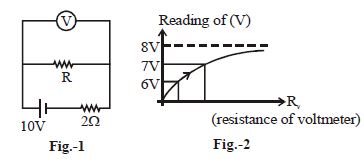
- 5In the given figure $-1$, resistance of shown voltmeter is variable. Variation of whose reading with respect to its resistance is shown in figure $-2$. The value of $R$ is ............... $\Omega$View Solution
- 6$n$ equal cell having emf $E$ and internal resistance $r$, are connected in a circuit of a resistance $R$ . Same current flows in circuit either they are connected in series or parallel, ifView Solution
- 7Three resistors of $4\,\Omega ,6\,\Omega $ and $12\,\Omega $ are connected in parallel and the combination is connected in series with a $1.5\, V$ battery of $1\,\Omega $ internal resistance. The rate of Joule heating in the $4\,\Omega $ resistor is ................ $W$View Solution
- 8Current density in a cylindrical wire of radius $R$ is given as $J =$ $\left\{ {\begin{array}{*{20}{c}}View Solution
{{J_0}\left( {\frac{x}{R} - 1} \right)\,\,for\,\,0 \leqslant x < \frac{R}{2}} \\
{{J_0}\frac{x}{R}\,\,\,\,for\,\,\,\frac{R}{2} \leqslant x \leqslant R}
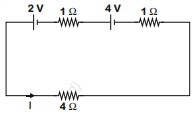
\end{array}} \right.$The current flowing in the wire is: - 9For the circuit shown in the figure, the current $I$ will be .......$A$View Solution
- 10The reading of the ammeter in the adjoining figure will be .............. $A$View Solution