In the circuit shown, the current in the $1\,\Omega$ resistor is
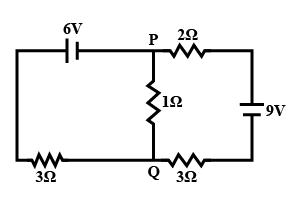
JEE MAIN 2015,AIPMT 1988, Medium
Download our app for free and get started
From $KVL$
$-6+3 I_{1}+1\left(I_{i}-I_{2}\right)=0$
$6=3 \mathrm{I}_{1}+\mathrm{I}_{1}-\mathrm{I}_{2}$
$4 \mathrm{I}_{1}-\mathrm{I}_{2}=6$ .....$(1)$
$-9+2 I_{2}-\left(I_{1}-I_{2}\right)+3 I_{2}=0$
$-\mathrm{I}_{1}+6 \mathrm{I}_{2}=9$ ....$(2)$
On solving $( 1)$ and $( 2)$
$\mathrm{I}_{1}=0.13\, \mathrm{A}$
Direction $Q$ to $P,$ since $I_{1}>I_{2}$.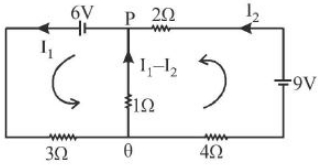

Download our appand get started for free
Experience the future of education. Simply download our apps or reach out to us for more information. Let's shape the future of learning together!No signup needed.*
Similar Questions
- 1View SolutionIf a high power heater is connected to electric mains, then the bulbs in the house become dim, because there is a
- 2In an experiment of potentiometer for measuring the internal resistance of primary cell a balancing length $\ell $ is obtained on the potentiometer wire when the cell is open circuit. Now the cell is short circuited by a resistance $R$. If $R$ is to be equal to the internal resistance of the cell the balancing length on the potentiometer wire will beView Solution
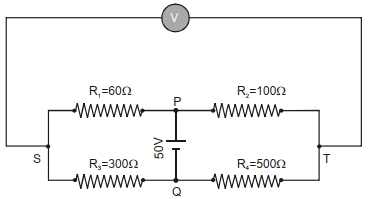
- 3In the balanced condition, the values of the resistances of the four arms of a Wheatstone bridge are shown in the figure below. The resistance $R_3$ has temperature coefficient $0.0004{ }^{\circ} C ^{-1}$. If the temperature of $R_3$ is increased by $100{ }^{\circ} C$, the voltage developed between $S$ and $T$ will be. . . . . . . volt.View Solution
- 4It is preferable to measure the $e.m.f.$ of a cell by potentiometer than by a voltmeter because of the following possible reasons.View Solution
$(i)$ In case of potentiometer, no current flows through the cell.
$(ii)$ The length of the potentiometer allows greater precision.
$(iii)$ Measurement by the potentiometer is quicker.
$(iv)$ The sensitivity of the galvanometer, when using a potentiometer is not relevant.
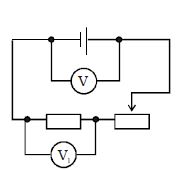
Which of these reasons are correct? - 5If the rheostat slider were to move from the extreme right to the far left, How will the reading of voltmeter $V_1$ change?View Solution
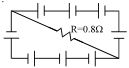
- 6$\mathrm{A}$ circuit is comprised of eight identical batteries and a resistor $R = 0.8\,\Omega$ . Each battery has an $\mathrm{emf}$ of $1.0\, V$ and internal resistance of $0.2\,\Omega$ . The voltage difference across any of the battery is ............. $V$View Solution
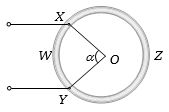
- 7A wire of resistor $R$ is bent into a circular ring of radius $r$. Equivalent resistance between two points $X$ and $Y$ on its circumference, when angle $XOY$ is $\alpha$, can be given byView Solution
- 8The resistance of a wire is $5\,ohm$ at $50\,^o C$ and $6\,ohm $ at $100\,^o C$. The resistance of the wire at $0\,^o C$ will be .............. $\Omega$View Solution
- 9An electron (charge $= 1.6 × 10^{-19}$ coulomb) is moving in a circle of radius $5.1 × 10^{-11}\,m$ at a frequency of $6.8 × 10^{15} $ revolutions/sec. The equivalent current is approximatelyView Solution
- 10A heating coil can heat the water of a vessel from $20\,^oC$ to $60\,^oC$ in $30$ minutes. Two such heating coils are put in series and then used to heat the same amount of water through the same temperature range. The time taken now will be ............ $min$ (neglecting thermal capacity of the coils)View Solution