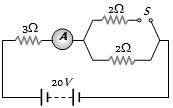
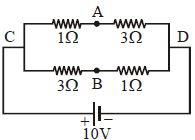
In the circuit shown, the reading of ammeter when switch $S$ is open and when switch $S$ is closed respectively are
Medium


Download our appand get started for free
Experience the future of education. Simply download our apps or reach out to us for more information. Let's shape the future of learning together!No signup needed.*
Similar Questions
- 1The length of a potentiometer wire is $1200\; \mathrm{cm}$ and it carries a current of $60 \;\mathrm{mA}$. For a cell of $emf\;5\; \mathrm{V}$ and intemal resistance of $20\; \Omega,$ the null point on it is found to be a $1000\; \mathrm{cm} .$ The resistance of whole wire is .............. $\Omega$View Solution
- 2An electron (charge $= 1.6 × 10^{-19}$ coulomb) is moving in a circle of radius $5.1 × 10^{-11}\,m$ at a frequency of $6.8 × 10^{15} $ revolutions/sec. The equivalent current is approximatelyView Solution
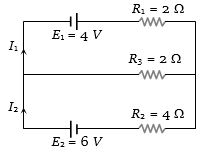
- 3In the circuit shown below $E_1 = 4.0 \,V, R_1= 2 \Omega, E_2 = 6.0 \,V, R_2 = 4 \,\Omega$ and $R_3 = 2 \,\Omega$. The current $I_1$ is ..................... $A$View Solution
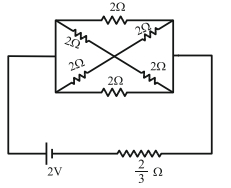
- 4In the following circuit, the battery has an emf of $2\mathrm{V}$ and an internal resistance of $\frac{2}{3}\ \Omega$. The power consumption in the entire circuit is$..... W.$View Solution
- 5Two identical fuses are rated at $10\,A$. If they are joinedView Solution
- 6The charge flowing through a resistance $R$ varies with time according to $Q = at -bt^2.$ The total heat produced in $R$ is : (assume that direction of current not reversed)View Solution
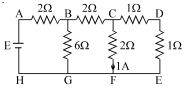
- 7The figure shows a network of resistors and $a$ battery. If $1\,A$ current flowsthrough the branch $CF$, then answer the following questions The $\mathrm{emf}$ $E$ of the battery is If a zero resistance wire is connected in parallel to branch $CF$ ............... $V$View Solution
- 8A battery of $emf$ $10\,V$ is connected to resistances as shown in the figure. The potential difference between $A$ and $B,\,\,(V_A -V_B)$ is ................ $V$View Solution
- 9Two batteries with e.m.f $12\ V$ and $13\ V$ are connected in parallel across a load resistor of $10\,\Omega$ . The internal resistances of the two batteries are $1\,\Omega$ and $2\,\Omega$ respectively. The voltage across the load lies betweenView Solution
- 10You are given a resistance wire of length $50\, cm$ and a battery of negligible resistance. In which of the following cases is largest amount of heat generatedView Solution