MCQ
In the electrolysis of $\text{NaCl:}$
  • $Cl ^{-}$is oxidised at anode.
  • B
    $Cl ^{-}$ is reduced at anode.
  • C
    $Cl ^{-}$ is reduced at cathode.
  • D
    $Cl ^{-}$ is neither reduced nor oxidised.

Answer

Correct option: A.
$Cl ^{-}$is oxidised at anode.

Electrolysis of an aqueous solution of table salt $(\text{NaCl}$, or sodium chloride$)$ produces aqueous sodium hydroxide and chlorine, although usually only in minute amounts. $\text{NaCl} ($aq$)$ can be reliably electrolysed to produce hydrogen. Hydrogen gas will be seen to bubble up at the cathode, and chlorine gas will bubble at the anode.
As the electricity from the battery passes through and between the electrodes, the water splits into hydrogen and chlorine gas, which collect as very tiny bubbles around the electrode tips. Hydrogen collects around the cathode and chlorine gas collects around the anode.

Need a full question paper?

Generate a complete, print-ready paper with questions like this in minutes — across 16+ boards, with answer keys.
Start Generating Free

Similar questions

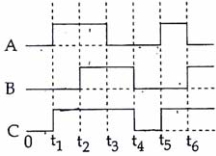
The figure shows a logic circuit with two inputs $A$ and $B$ and the output $C.$ The voltage wave forms across $A, B$ and $C$ are as given. The logic circuit gate is
When a resistance of $5\,\Omega$ is shunted with a moving coil galvanometer, it shows a full scale deflection for a current of $250\,mA$, however when $1050\,\Omega$ resistance is connected with it in series, it gives full scale deflection for $25$ volt. The resistance of galvanometer is $......\,\Omega$.
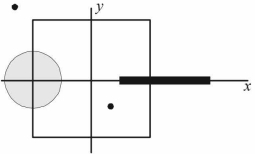
A disk of radius $a / 4$ having a uniformly distributed charge $6 C$ is placed in the $x-y$ plane with its centre at $(-a / 2,0,0)$. A rod of length $a$ carrying a uniformly distributed charge $8 C$ is placed on the $x$-axis from $x=a / 4$ to $x=5 a / 4$. Two point charges $-7 C$ and $3 C$ are placed at $(a / 4,-$ $a / 4,0)$ and $(-3 a / 4,3 a / 4,0)$, respectively. Consider a cubical surface formed by six surfaces $x=\pm a / 2, y=\pm a / 2, z=\pm a / 2$. The electric flux through this cubical surface is
Which of the following particles will have minimum frequency of revolution when projected with the same velocity perpendicular to a magnetic field?
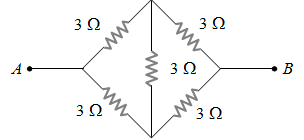
The equivalent resistance of the following diagram A and B is
In the ideal double-slit experiment, when a glass-plate (refractive index 1.5) of thickness t is introduced in the path of one of the interfering beams (wavelength l), the intensity at the position where the central maximum occurred previously remains unchanged. The minimum thickness of the glass-plate is 
Hydrogen atoms are excited from ground state of the principal quantum number 4. Then the number of spectral lines observed will be
In a potentiometer experiment two cells of $e.m.f.$ $E_1$ and $E_2$ are used in series and in conjunction and the balancing length is found to be $58\, cm$ of the wire. If the polarity of $E_2$ is reversed, then the balancing length becomes $29\, cm$. The ratio $\frac{{{E_1}}}{{{E_2}}}$ of the $e.m.f.$ of the two cells is
If two electric bulbs have $40\,W$ and $60\,W$ rating at $220\,V$, then the ratio of their resistances will be
The image formed by the convex mirror of a real object is larger than the object