Question
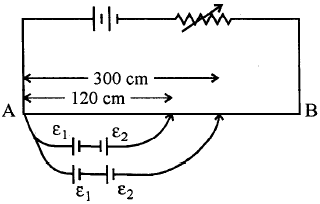
In the figure a long uniform potentiometer wire $AB$ is having a constant potential gradient along its length. The null points for the two primary cells of emfs $\varepsilon_{1}$ and $\varepsilon_{2}$
connected in the manner shown are obtained at a distance of $120 \ cm $ and $300 \ cm$ from the end $A$.
Find $(i) \varepsilon_{1} / \varepsilon_{2}$ and $(ii)$ position of null point for the cell $\varepsilon_{1}$. How is the sensitivity of a potentiometer increased?
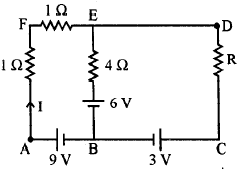
Using Kirchoffs rules determine the value of unknown resistance $R$ in the circuit so that no current flows through 4 $\Omega$ resistance. Also find the potential difference between $A$ and $D.$
Answer

  1. $\varepsilon_{1} + \varepsilon_{2} = 300k \ (k$ is potential gradient in $\text{volt/cm)}$
$\varepsilon_{1} - \varepsilon_{2} = 120 \text{k}$
$\Rightarrow\frac{\varepsilon_{1}}{\varepsilon_{2}} = 7 / 3$
  1. $\varepsilon_{1} + \varepsilon_{2} = 300\text{k}$
$\therefore\varepsilon_{1} + \frac{3}{7}\varepsilon_{1} = 300 \text{k}$
$\Rightarrow\varepsilon_{1} = 210 \text{k}$
Therefore, balancing length for cell $\varepsilon_{1}$ is $210\ cm.$
  1. By decreasing potential gradient.
$[$Or through Increasing length, reducing potential drop across wire, increasing resistance put in series with the main cell etc.$]$
Alternate Answer
Applying Kirchhoff's Voltage rule
for loop $\text{ABEFA}$
$-9 + 6 + 4 x 0 +2 I = 0$
$2 I – 3 = 0$
$\text{I} =\frac{3}{2}\text{A} = 1.5\text{A}$
For loop $\text{BCDEB}$
$3 + I R + 4 x 0– 6 = 0$
$\therefore\text{IR} = 3 $
Substituting the value of current $I,$
$\frac{3}{2}\times\text{R} = 3 $
$\therefore\text{R} = 2\Omega$
Potential difference between $A D$
Through path $\text{ABCD}$
$+9V – 3V – IR = V_{AD}$
$ + 9 - 3 - \frac{3}{2}\times2 = \text{V}_{AD}$
$\Rightarrow\text{V}_{AD} = 3\text{V}$
Alternate Answer
through path $\text{AFD}$
$\frac{3}{2}\times2 =\text{V}_{AD}$
$\Rightarrow\text{V}_{AD} = 3 \text{V}.$

Need a full question paper?

Generate a complete, print-ready paper with questions like this in minutes — across 16+ boards, with answer keys.

Start Generating Free

Similar questions

The sunlight reaching Earth has maximum electric field of $810\ Vm^{-1}.$ What is the maximum magnetic field in this light?
When a photon is emitted by a hydrogen atom, the photon carries a momentum with it. $(a)$ Calculate the momentum carries by the photon when a hydrogen atom emits light of wavelength $656.3\ nm. (b)$ With what speed does the atom recoil during this transition? Take the mass of the hydrogen atom $= 1.67 \times 10^{-27}kg. (c)$ Find the kinetic energy of recoil of the atom.
A uniform conducting wire of length $12a$ and resistance $R$ is wound up as a current carrying coil in the shape of:
  1. An equilateral triangle of side $a.$
  2. A square of sides $a.$
  3. A regular hexagon of sides $a.$ The coil is connected to a voltage source $V_0.$ Find the magnetic moment of the coils in each case.
When a capacitor is connected in series $LR$ circuit, the alternating current flowing in the circuit increases. Explain why.
A proton is projected with a velocity of $3 \times 10^6 ms^{-1}$ perpendicular to a uniform magnetic field of $0.6T.$ Find the acceleration of the proton.
  1. At what distance should the lens be held from the figure in Exercise 9.29 in order to view the squares distinctly with the maximum possible magnifying power?
  2. What is the magnification in this case?What is the magnification in this case?
  3. Is the magnification equal to the magnifying power in this case? Explain.
A change of 0.2mA in the base current causes a change of 5mA in the collector current for a common emitter amplifier.
  1. Find the ac current gain of the transistor.
  2. If the input resistance is $2\text{k}\Omega$ and its voltage gain is 75, calculate the load resistor used in the circuit.
Explain the application of $p-n$ junction diode as a full-wave rectifier.
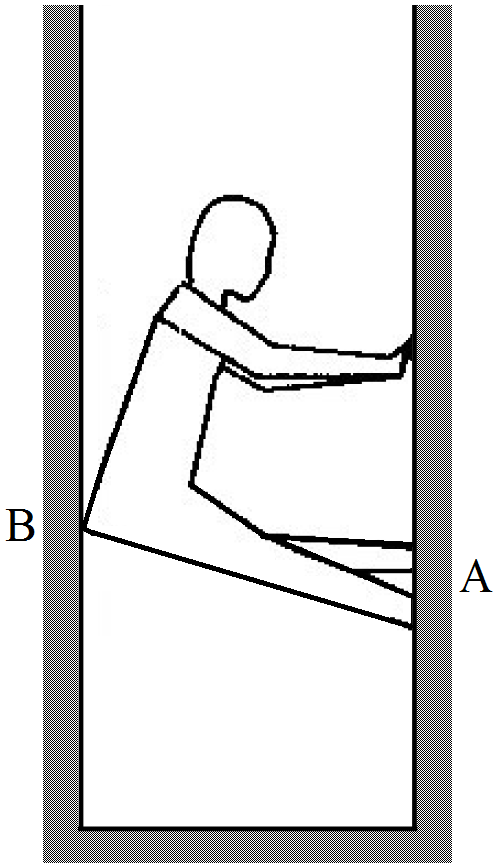
A person $(40\ kg)$ is managing to be at rest between two vertical walls by pressing one wall A by his hands and feet and the other wall B by his back. Assume that the friction coefficient between his body and the walls is $0.8$ and that limiting friction acts at all the contacts.
  1. Show that the person pushes the two walls with equal force.
  2. Find the normal force exerted by either wall on the person. Take $g = 10m/s^2.$
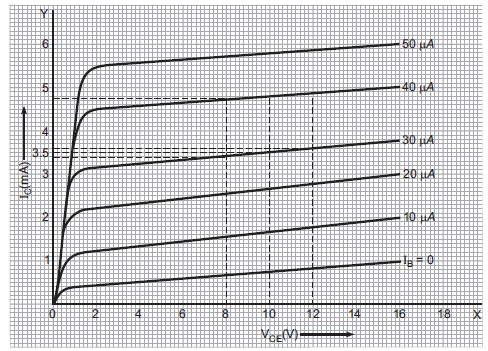
Output characteristics of an $n-p-n$ transistor in $CE$ configuration is shown in the figure. Determine:
  1. Dynamic output resistance.
  2. $Dc$ current gain and.
  3. $Ac$ current gain at an operating point $V_{CE} = 10V,$ when $ I_B =30\mu\ A$.