Question
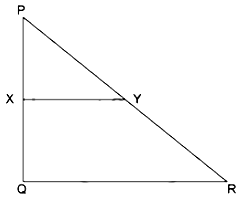
In the figure, given below, PQR is a right-angle triangle right angled at Q. XY is parallel to QR, PQ = 6 cm, PY = 4 cm and PX : XQ = 1 : 2. Calculate the lengths of PR and QR.
Answer

Given that $\frac{P X}{X Q}=\frac{1}{2}$ and $XY \| QR$
So, $\frac{P X}{X Q}=\frac{P Y}{Y R}=\frac{1}{2}$
Since PY = 4cm, YR = 8cm.
Hence, PR = 12 cm
Since ΔPQR is a right-angled triangle
By Pythagoras theorem,
$Q R^2=P R^2-P Q^2$
$\Rightarrow Q R^2=12^2-6^2$
$\Rightarrow Q R^2=144-36$
$\Rightarrow Q R^2=108$
$\Rightarrow QR =10.39 cm$

Need a full question paper?

Generate a complete, print-ready paper with questions like this in minutes — across 16+ boards, with answer keys.
Start Generating Free

Similar questions

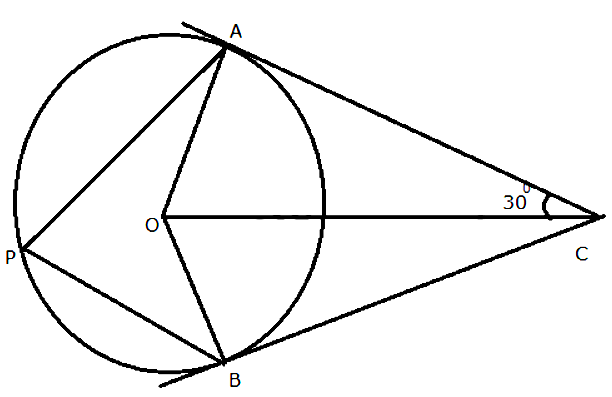
In the given figure, O is the centre of the circle. Tangents at A and B meet at C. If angle ACO = 30°, find: angle AOB
A shopkeeper bought a washing machine at a discount of 20% from a wholesaler, the printed price of the washing machine being Rs. 18,000. The shopkeeper sells it to a consumer at a discount of 10% on the printed price. If the rate of sales tax is 8%, find:
(i) the VAT paid by the shopkeeper.
(ii) the total amount that the consumer pays for the washing machine
The radius of the internal and external surfaces of a hollow spherical shell are $3 cm$ and $5 cm$ respectively! If it is melted and recast into a solid cylinder of height $\frac{8}{3}$ cm, find the diameter of the cylinder.
Find the value of x, if $cos(2x - 6) = \cos^230^\circ - \cos^260^\circ$
Prove the following identity:
$
\frac{\cos A}{1-\tan A}+\frac{\sin A}{1-\cot A}=\sin A+\cos A
$
Mr. Pankaj took Health Insurance Policy for his family and paid Rs. 900 as SGST. Find the total annual premium paid by him for this policy, rate of GST being 18%.
Find two consecutive positive even integers whose squares have the sum $340.$
Prove the following identity:
$
\frac{1+\cos A}{1-\cos A}=(\operatorname{cosec} A+\cot A)^2
$
A line $P Q$ is drawn paral el to the base $B C$ of $\triangle A B C$ which meets sides $A B$ and $A C$ at points $P$ and $Q$ respectively. If $AP =\frac{1}{3} PB$; find the value of:
1) $\frac{\text { Area of } \triangle ABC }{\text { Area of } \triangle APQ }$
2) $\frac{\text { Area of } \triangle APQ }{\text { Area of trapeziumPBCQ }}$
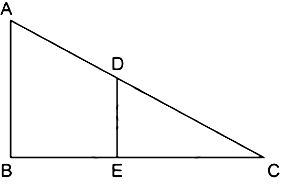
In the given figure, $AB$ and $DE$ are perpendiculars to $BC.$
Find the ratio of the area of a $\triangle ABC :$ area of $\triangle DEC.$