Question
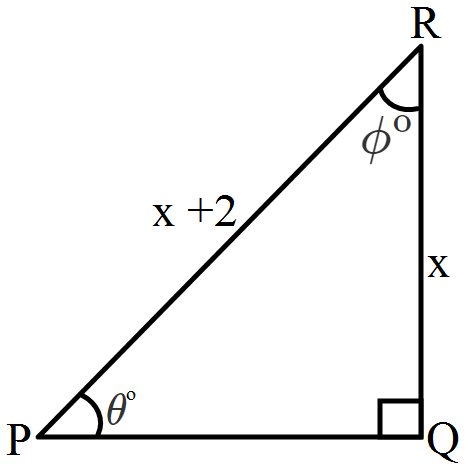
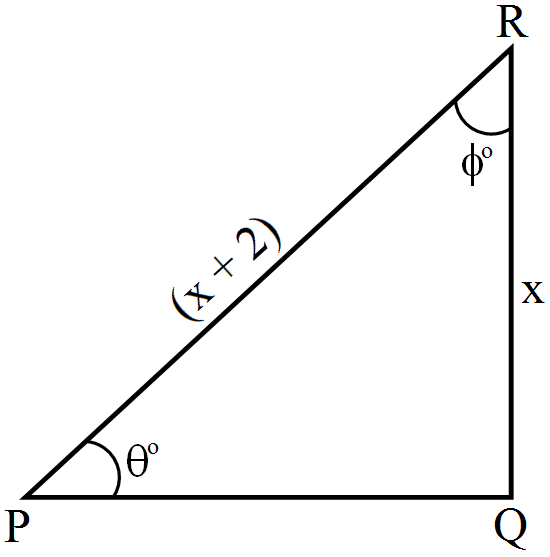
In the figure of $\triangle\text{PQR},\angle\text{P}=\theta^\circ$and $\angle\text{R}=\phi^\circ.$
Find:
  1. $\big(\sqrt{\text{x}+1}\big)\cot\phi$
  2. $\big(\sqrt{\text{x}^3+\text{x}^2}\big)\tan\theta$
  3. $\cos\theta$

Answer


In $\triangle\text{PQR},\angle\text{Q}=90^\circ,\angle\text{P}=\theta^\circ$ and $\angle\text{R}=\phi^\circ$
By Pythagoras theorem, we have
$\text{PQ}^2=\text{PR}^2-\text{QR}^2$
$=\big(\text{x}+2\big)^2-\text{x}^2=\text{x}^2+4\text{x}+4-\text{x}^2=4(\text{x}+1)$
$\Rightarrow\text{PQ}=2\sqrt{\text{x}+1}$
Now, $\cot\phi=\frac{\text{QR}}{\text{PQ}}=\frac{\text{x}}{2\sqrt{\text{x}+1}}$ and $\tan\theta=\frac{\text{QR}}{\text{PQ}}=\frac{\text{x}}{2\sqrt{\text{x}+1}}$
$\big(\sqrt{\text{x}+1}\big)\cot\phi=\big(\sqrt{\text{x}+1}\big)\times\frac{\text{x}}{2\sqrt{\text{x}+1}}=\frac{\text{x}}{2}$
$\big(\sqrt{\text{x}^3+\text{x}^2}\big)\tan\theta=\big(\sqrt{\text{x}^2(\text{x}+1)}\big)\\\tan\theta=\text{x}\big(\sqrt{\text{x}+1}\big)\times\frac{\text{x}}{2\sqrt{\text{x}+1}}=\frac{\text{x}^2}{2}$
$\cos\theta=\frac{\text{PQ}}{\text{PR}}=\frac{2\sqrt{\text{x}+1}}{\text{x}+2}$

Need a full question paper?

Generate a complete, print-ready paper with questions like this in minutes — across 16+ boards, with answer keys.

Start Generating Free

Similar questions

A train covered a certain distance at a uniform speed. If the train had been 5 kmph faster, it would have taken 3 hours less than the scheduled time. And, If the train were slower by 4 kmph, it would have taken 3 hours more than the scheduled time. Find the length of the journey.
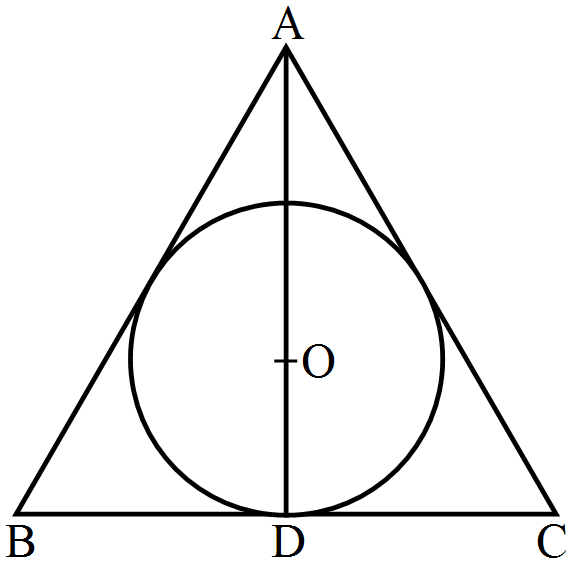
In the given figure, a circle is inscribed in an equilateral triangle $ABC$ of side $12\ cm$. Find the radius of inscribed circle and the area of the shaded region. $\big[\text{Use}\sqrt{3}=1.73\text{ and }\pi=3.14\big]$
If twice the son's age in years is added to the father's age, the sum is 70 years. But, if twice the father's age is added to the son's age, the sum is 95 years. Find the age of the father and son.
The marks obtained by 100 students of a class in an examination are given below:
Marks
Number of students
0-5
2
5-10
5
10-15
6
15-20
8
20-25
10
25-30
25
30-35
20
35-40
18
40-45
4
45-50
2
Draw cumulative frequency curves by using
  1. 'less than' series and
  2. 'more than' series
Hence, find the median.
Solve the following system of equations graphically:
2x + 3y = 2,
x - 2y = 8
The sum of two numbers is 137 and their difference is 43. Find the numbers.
In a school, students decided to plant trees in and around the school to reduce air pollution. it was decided that number of trees that each section of each class will plant will be double of the class in which they are studying. If there are 1 to 12 classes in the school and each class has two sections, find how many trees were planted by students. Which value is shown in the question?
If $\text{x}=\text{cosec}\text{A}+\cos\text{A}$ and $\text{y}=\text{cosec}\text{A}-\cos\text{A}$ then Prove that $\Big(\frac{2}{\text{x}+\text{y}}\Big)^2+\Big(\frac{\text{x}-\text{y}}{2}\Big)^2-1=0.$
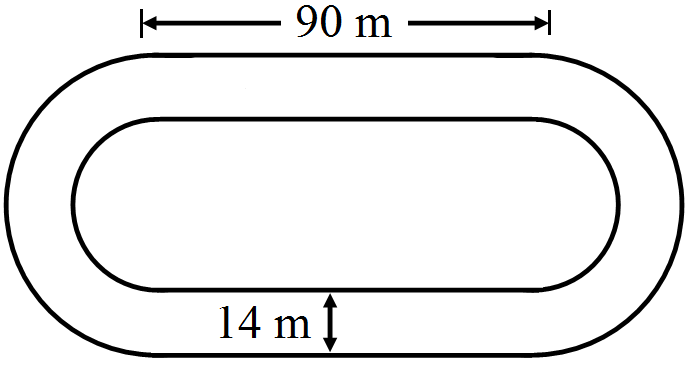
The inside perimeter of a running track shown in the shown in the figure is 400m. the length of the straigth portions is 90m, and the ends are semicicles. if the track. Also find the length of the outer boundary of the track. $\Big[\text{Use }\pi=\frac{22}{7}\Big]$
The frequency distribution table of more than type is as follows:
Production yield (kg/ha) (lower class limits) Cumulative frequency (cf)
More than 50 2 + 98 = 100
More than 55 8 + 90 = 98
More than 60 12 + 78 = 90
More than 65 24 + 54 = 78
More than 70 38 + 16 = 54
More than 75 16
Taking the lower class limits on x-axis and their respective cumulative frequencies on y-axis, its ogive can be obtained as follows: