MCQ
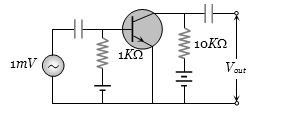
In the following common emitter configuration an $NPN $ transistor with current gain $\beta$ $= 100$ is used. The output voltage of the amplifier will be
  • A
    $10\, mV$
  • B
    $0.1 \,V$
  • $1.0 \,V$
  • D
    $10\, V$

Answer

Correct option: C.
$1.0 \,V$
c
(c)Voltage gain $ = \frac{{{\rm{Output voltage}}}}{{{\rm{Input voltage}}}}$
$⇒ V_{out} = V_{in} ×$ Voltage gain
$⇒$$ V_{out} = V_{in} ×$ Current gain $×$ Resistance gain
$= V_{in} ×\beta × \frac{{{R_L}}}{{{R_{BE}}}}$= ${10^{ - 3}} \times 100 \times \frac{{10}}{1} = 1V.$

Need a full question paper?

Generate a complete, print-ready paper with questions like this in minutes — across 16+ boards, with answer keys.

Start Generating Free

Similar questions

A body of mass $10 kg$ is projected at an angle of $45^{\circ}$ with the horizontal. The trajectory of the body is observed to pass through a point $(20,10)$. If $T$ is the time of flight, then its momentum vector, at time $t =\frac{ T }{\sqrt{2}}$, is.

$\left[\right.$ Take $\left.g=10 m / s ^{2}\right]$
Water drops are falling from a nozzle of a shower onto the floor, from a height of $9.8\, {m}$. The drops fall at a regular interval of time. When the first drop strikes the floor, at that instant, the third drop begins to fall. Locate the position of second drop from the floor when the first drop strikes the floor.  (In $m$)
Two metallic spheres of radii $1\,\, cm$ and $3\,\, cm$ are given, charges of $-1$$ \times {10^{ - 2}}$ $C$ and $5$$ \times {10^{ - 2}}\,C$ respectively. If these are connected by a conducting wire, the final charge on the bigger sphere is
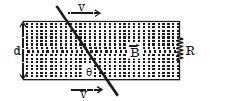
A conducting rod with resistance $r$ per unit  length is moving inside a vertical magnetic field $\vec B$ at constant speed $v$ on two horizontal parallel ideal conductor rails.The ends of the rails ae connected to a resistor $R.$ The separation between the rails is $d.$ The rod maintains a tilted angle $\theta$ to the rails. Find the external force required to keep the rod moving.
In a series circuit $R = 300\,  \Omega$, $L = 0.9$ $ H, C = 2.0\, \mu$$F$ and $\omega$= $1000 \,rad/sec$. The impedance of the circuit is........$\Omega$
The magnetic field of an E.M. wave is given by $\vec{B}=\left(\frac{\sqrt{3}}{2} \hat{i}+\frac{1}{2} \hat{j}\right) 30 \sin \left[\omega\left(t-\frac{z}{c}\right)\right]$ (S.I. Units) The corresponding electric field in S.I. units is :
The length of a potentiometer wire is $\ell $.  A cell of emf $E$ is balanced at a length $\ell /3$  from the positive end of the wire. If the length of the wire is increased by $\ell /2$ at what distance will the same cell give a balanced point
A ball is thrown from ground at an angle $\theta$ with horizontal and with an initial speed $u_0$. For the resulting projectile motion, the magnitude of average velocity of the ball up to the point when it hits the ground for the first time is $V _1$. After hitting the ground, ball rebounds at the same angle $\theta$ but with a reduced speed of $u_0 / \alpha$. Its motion continues for a long time as shown in figure. If the magnitude of average velocity of the ball for entire duration of motion is $0.8 V _1$, the value of $\alpha$ is. . . . . .
A varying current in a coil changes from $10\, amp$ to zero in $0.5 \,sec$. If average $EMF$ is induced in the coil is $220 \,volts$, the self inductance of coil is....$H$
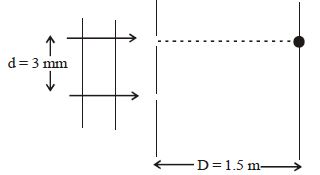
In a $YDSE$ light of two different wavelengths ( $\lambda_1$ & $\lambda_2$) are incident normal to the plane of slits. The $n^{th}$ maxima of $\lambda_1$ coincides with the $m^{th}$ maxima of $\lambda_2$ exactly in front of one of the slits.

Given $D = \ 1.5\  m$
$d = 3\  mm$
$4500 \ Å < \lambda_1 , \lambda_2 < 7000\  Å$
then $n, m$ and $\lambda_1$ are