MCQ
In the following compounds, the decreasing order of basic strength will be
  • A
    $C_2H_5NH_2 > NH_3 > (C_2H_5)_2\, NH$
  • B
    $NH_3 > C_2H_5 NH_2 > (C_2H_5)_2\, NH$
  • $(C_2H_ 5)_2 NH > C_2H_5NH_2 > NH_3$
  • D
    $(C_2H_ 5)_2 NH > NH_3 >C_2H_5 NH_2$

Answer

Correct option: C.
$(C_2H_ 5)_2 NH > C_2H_5NH_2 > NH_3$
c
Basic strength order
$(CH_3CH_2)_2NH > CH_3CH_2NH_2 > NH_3$
More the number of $+I$ groups, higher is the basic strength.

Need a full question paper?

Generate a complete, print-ready paper with questions like this in minutes — across 16+ boards, with answer keys.
Start Generating Free

Similar questions

What will be the equivalent weight of $K _2 Cr _2 O _7$ is molecular weight $= M$ ?
The concentration of an aqueous solution of $0.01\,M\,\,C{H_3}OH$ solution is very nearly equal to which of the following
The difference in electronegativity of carbon-halogen bond is minimum in:
Which of the following is obtained by reducing methyl cyanide with Na + C2​H5​OH?
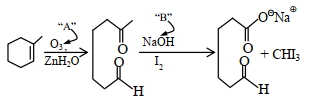
In the above chemical reaction sequence " $\mathrm{A}$ " and " $\mathrm{B}$ " respectively are :
Which of the following represent free radical substitution reaction $(FSR)$, electrophilic addition reaction $(EAR)$ and nucleophilic addition reaction $(NAR)$

$I.$ $CH_3 -CH = CH_2$ $\xrightarrow[{{\text{(CC}}{{\text{l}}_4}{\text{ )}}}]{{{\text{C}}{{\text{l}}_2}}}$ $\begin{array}{*{20}{c}}
{Cl\,\,}\\
{\,\,|\,\,\,\,\,}\\
{C{H_3} - CH - C{H_2}}\\
{\,\,\,\,\,\,\,\,\,\,\,\,\,\,\,\,\,\,\,\,\,\,\,\,\,\,|}\\
{\,\,\,\,\,\,\,\,\,\,\,\,\,\,\,\,\,\,\,\,\,\,\,\,\,\,\,Cl}
\end{array}$

$II.$ $\begin{array}{*{20}{c}}
O\\
{||}\\
{C{H_3} - C - C{H_3}}
\end{array}$ $\xrightarrow[{{}^\Theta OH}]{{{\text{HCN}}}}$ $\begin{array}{*{20}{c}}
{\,\,\,\,\,OH}\\
|\\
{C{H_3} - C - C{H_3}}\\
|\\
{\,\,\,\,\,CN}
\end{array}$

$III.$ $CH_3-CH_2-CH_3$ $\xrightarrow[{hv}]{{C{l_2}}}$ $\begin{array}{*{20}{c}}
{Cl\,\,}\\
{|\,\,\,\,}\\
{C{H_3} - CH - C{H_3}}
\end{array}$
Point out the wrong statement :For a first order reaction
The "spin-only" magnetic moment [ in units of Bohrmagneton, $(\mu _B )$ ] of $Ni^{2+}$ in aqueous solution would be (At. No. $Ni= 28)$
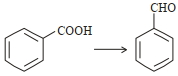
The reagent, from the following, which converts benzoic acid to benzaldehyde in one step is
On hydrolysis, which produces only glucose