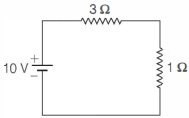
In the following circuit, $1 \,\Omega$ resistor dissipates power $P$. If the resistor is replaced by $9 \,\Omega$, the power dissipated in it is
KVPY 2011, Medium
Download our app for free and get started
(a)
From given circuit, if $i=$ circuit current, then
$V=i R_{ eq } \Rightarrow i=\frac{10}{4}=2.5 \,A$
So, power dissipated by circuit is
$P=i^2 R=(2.5)^2 \times 1=\frac{25}{4} W$
When $1 \,\Omega$ resistor is replaced by a $9 \,\Omega$ resistor, then power dissipated in $9\, \Omega$ resistor is
$P^{\prime}=\left(\frac{10}{12}\right)^2 \times(9)$
$=\frac{100 \times 9}{12 \times 12}=\frac{25}{4} \,W$
So, $P^{\prime}=P$

Download our appand get started for free
Experience the future of education. Simply download our apps or reach out to us for more information. Let's shape the future of learning together!No signup needed.*
Similar Questions
- 1A current of $5\; {A}$ is passing through a non-linear magnesium wire of cross-section $0.04\; {m}^{2}$. At every point the direction of current density is at an angle of $60^{\circ}$ with the unit vector of area of cross-section. The magnitude of electric field at every point of the conductor is ....${V} / {m}$ (Resistivity of magnesium is $\rho=44 \times 10^{-8}\, \Omega m$)View Solution
- 2View SolutionTwo heating coils, one of fine wire and the other of thick wire of the same material and of the same length are connected in series and in parallel. Which of the following statement is correct
- 3A meter bridge is set up as shown, to determine an unknown resistance ' $X$ ' using a standard $10\,ohm$ resistor. The galvanometer shows null point when tapping-key is at $52\,cm$ mark. The endcorrections are $1\,cm$ and $2\,cm$ respectively for the ends $A$ and $B$. The determined value of ' $X$ ' is $..........\Omega$View Solution
- 4In a conductor, if the number of conduction electrons per unit volume is $8.5 \times 10^{28}\, m^{-3}$ and mean free time is $25\,fs$ (femto second), its approximate resistivity is $\left( {{m_e} = 9.1 \times {{10}^{ - 31}}\,kg} \right)$View Solution
- 5Two bulbs, one of $200 \,W$ and the other of $100 \,W$ are connected in series with a $100 \,V$ battery which has no internal resistance. Then,View Solution
- 6Four wires of the same diameter are connected in turn between two points, maintained at a constant potential difference. Their resistivities are; $\rho $ and $L$ (wire $1$ )., $1.2\,\rho $ and $1.2\,L$ (wire $2$ ), $0.9\,\rho $ and $0.9\,L$ (wire $3$ ) and $\rho $ and $1.5\,L$ (wire $4$ ). Rank the wires according to the rates at which energy is dissipated as heat, greatest firstView Solution
- 7In the circuit shown : $E_1 = 4.0\ V, R_1 = 2 \ \Omega,$$ E_2 = 6.0\ V, R_2 = 4\ \Omega$ and $R_3 = 2\ \Omega.$ The current $I_1$ is : ................ $A$View Solution
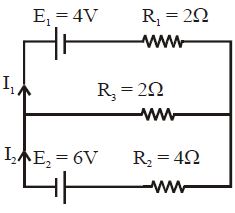
- 8To measure the internal resistance of a battery, potentiometer is used. For $\mathrm{R}=10 \Omega$, the balance point is observed at $\ell=500 \mathrm{~cm}$ and for $\mathrm{R}=1 \Omega$ the balance point is observed at $\ell=400 \mathrm{~cm}$. The internal resistance of the battery is approximately :View Solution
- 9View SolutionFollowing figure shows four situations in which positive and negative charges moves horizontally through a region and gives the rate at which each charge moves. Rank the situations according to the effective current through the region greatest first
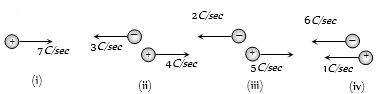
- 10Three resistors having resistances $\mathrm{r}_{1}, \mathrm{r}_{2}$ and $\mathrm{r}_{3}$ are connected as shown in the given circuit. The ratio $\frac{i_{3}}{i_{1}}$ of currents in terms of resistances used in the circuit is :View Solution