Question
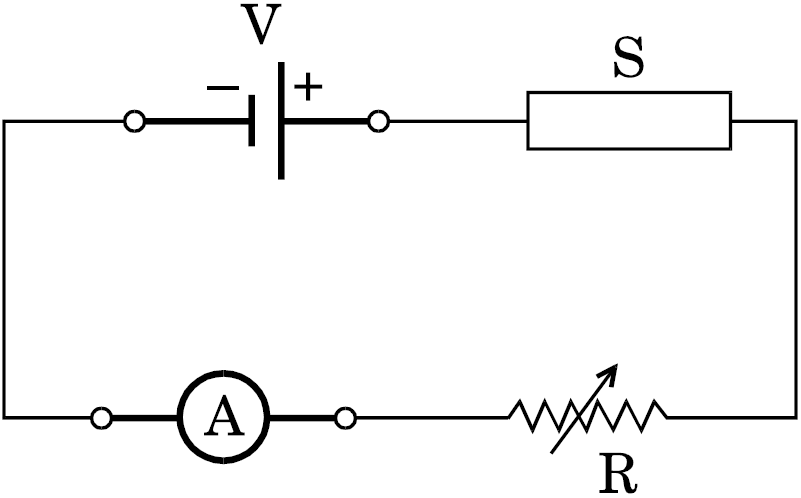
  1. In the following diagram ‘S’ is a semiconductor. Would you increase or decrease the value of R to keep the reading of the ammeter A constant when S is heated? Give reason for your answer.
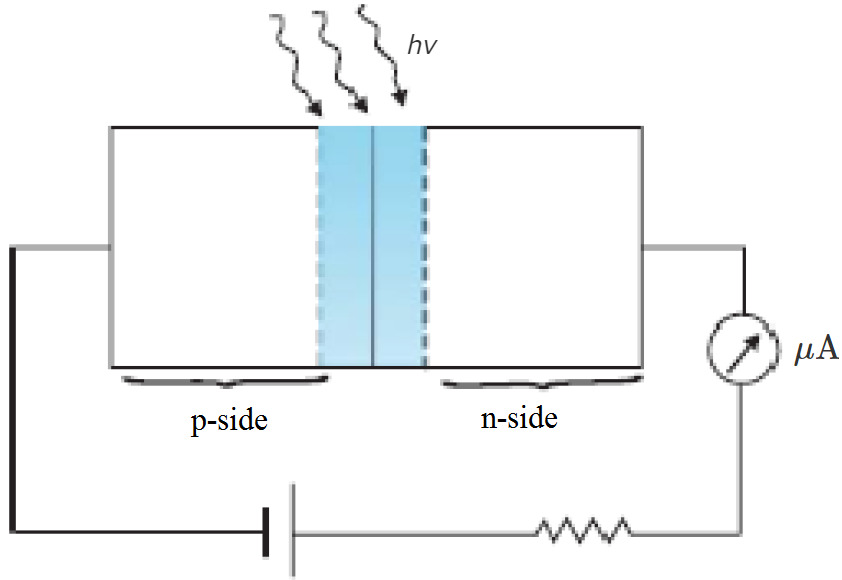
  1. Draw the circuit diagram of a photodiode and explain its working. Draw its I - V characteristics.
Answer

  1. R would be increased.
Resistance of S (a semi conductor) decreases on heating.
  1. Photodiode diagram:

When the photodiode is illuminated with light (photons) (with energy (hv) greater than the energy gap (Eg) of the semiconductor), then electron-hole pairs are generated due to the absorption of photons. Due to junction field, electrons and holes are separated before they recombine. Electrons are collected on n-side and holes are collected on p-side giving rise to an emf. When an external load is connected, current flows.
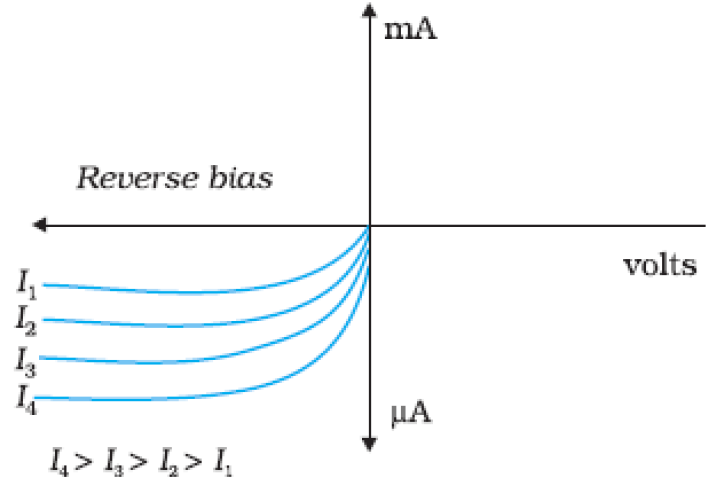
V-I Characteristics of the diode:

Need a full question paper?

Generate a complete, print-ready paper with questions like this in minutes — across 16+ boards, with answer keys.

Start Generating Free

Similar questions

Use Huygens's principle to explain the formation of diffraction pattern due to a single slit illuminated by a monochromatic source of light.
When the width of the slit is made double the original width, how would this affect the size and intensity of the central diffraction band?
What will be maximum mutual inductance between coils of self-inductance $L_1$ and $L_2$ ?
In a Wheatstone bridge $, P =1 \Omega, Q =2 \Omega, R =2 \Omega, S=3 \Omega$ and $R _{ g }=4 \Omega$. Find the current through the galvanometer in the unbalanced position of the bridge, when a battery of $2 V$ and internal resistance $2 \Omega$ is used.
A sample of air weighing $1.18g$ occupies $1.0 \times 10^3\ cm^3$ when kept at $300K$ and $1.0 \times 10^5Pa.$ When $2.0\ cal$ of heat is added to it at constant volume, its temperature increases by $1^\circ C.$ Calculate the amount of heat needed to increase the temperature of air by $1^\circ C$ at constant pressure if the mechanical equivalent of heat is $4.2 \times 10^7erg\ cal^{-1}.$ Assume that air behaves as an ideal gas.
A gas cylinder has walls that can bear a maximum pressure of $1.0 \times 10^6Pa.$ It contains a gas at $8.0 \times 10^5Pa$ and $300K.$ The cylinder is steadily heated. Neglecting any change in the volume, calculate the temperature at which the cylinder will break.
ls it always true that for two sources of equal intensity, the number of photons emitted in a given time are equal?
Can we find the mass of a photon by the definition p = mv?
A straight horizontal wire of mass 10mg and length 1.0m carries a current of 2.0A. What minimum magnetic field B should be applied in the region, so that the magnetic force on the wire may balance its weight?
Two identical tuning forks vibrating at the same frequency $256\ Hz$ are kept fixed at some distance apart. $A$ listener runs between the forks at a speed of $3.0\ m/s$ so that he approaches one tuning fork and recedes from the other figure. Find the beat frequency observed by the listener. Speed of sound in air $= 332\ ms/s.$
  1. Define torque acting on a dipole of dipole moment $\overrightarrow{p}$ placed in a uniform electric field $\overrightarrow{\text{E}}$. Express it in the vector form and point out the direction along which it acts
  2. What happens if the field is non-uniform?
  3. What would happen if the external field $\overrightarrow{\text{E}}$ is increasing (i) parallel to $\overrightarrow{p}$ and (ii) anti-parallel to $\overrightarrow{p}$?