Question
In the following figure; $A C=C D, A D=B D$ and $\angle C=58^{\circ}$.
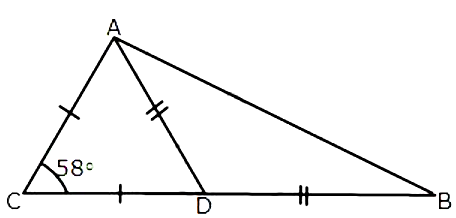
Find the $\angle CAB.$

Answer

In $\triangle ACD,$
$AC = CD ...[$ Given$]$
$\therefore \angle CAD = \angle CDA$
$\angle ACD = 58^\circ \dots...[$ Given$ ]$
$\angle ACD + \angle CDA + \angle CAD = 180^\circ $
$\Rightarrow 58^\circ + 2\angle CAD = 180^\circ $
$\Rightarrow 2\angle CAD = 122^\circ $
$\Rightarrow \angle CAD = \angle CDA = 61^\circ \dots...(i)$
Now,
$\angle CDA = \angle DAB + \angle DBA \dots...[$ Ext. angel is equal to sum of opp. int. angles $]$
But,
$\angle DAB = \angle DBA \dots...[$ Given $: AD = DB ]$
$\therefore \angle DAB +\angle DAB = \angle CDA$
$\Rightarrow 2\angle DAB = 61^\circ $
$\Rightarrow \angle DAB = 30.5^\circ \dots....(ii)$
In $\triangle ABC,$
$\angle CAB = \angle CAD +\angle DAB$
$\therefore \angle CAB = 61^\circ + 30.5^\circ $
$\Rightarrow \angle AB = 91.5^\circ $

Need a full question paper?

Generate a complete, print-ready paper with questions like this in minutes — across 16+ boards, with answer keys.

Start Generating Free