MCQ
In the following reaction

$\begin{matrix}
   \begin{matrix}
   C{{H}_{3}}\,\,\,\,\,\,\,\, \,\, \\
   |\,\,\,\,\,\,\,\,\,\,\,\,\,\,\,\,\,\,  \\
\end{matrix}  \\
   C{{H}_{3}}-C-CH=C{{H}_{2}}  \\
   |\,\,\,\,\,\,\,\,\,\,\,\,\,\,\,\,\,\,  \\
   C{{H}_{3}}\,\,\,\,\,\,\,\, \,\,\,\, \\
\end{matrix}\,$ $\xrightarrow{{{H}_{2}}O/{{H}^{\oplus }}}$ $\underset{Major\,\,product}{\mathop{A}}\,$ $+$ $\underset{Major\,\,product}{\mathop{B}}\,$

The major product is

  • A
    $\begin{array}{*{20}{c}}
    {C{H_3}\,\,\,\,\,\,\,\,\,}\\
    {|\,\,\,\,\,\,\,\,\,\,\,\,\,\,\,\,\,}\\
    {C{H_3} - C - CH - C{H_3}}\\
    {\,\,\,\,\,\,\,\,|\,\,\,\,\,\,\,\,\,|\,\,\,\,\,\,\,\,\,\,\,\,\,\,}\\
    {\,\,\,\,\,\,\,\,C{H_3}\,OH\,\,\,\,\,\,\,\,\,\,\,\,\,}
    \end{array}$
  • B
    $\begin{array}{*{20}{c}}
    {C{H_3}\,\,\,\,\,\,\,\,\,\,}\\
    {|\,\,\,\,\,\,\,\,\,\,\,\,\,\,\,\,\,\,}\\
    {C{H_3} - C - C{H_2} - C{H_2}}\\
    {\,\,\,\,\,\,\,\,\,\,\,\,\,\,\,\,\,\,\,\,\,\,\,\,\,\,\,\,\,\,\,\,\,\,|\,\,\,\,\,\,\,\,\,\,\,\,\,\,\,\,\,\,\,\,\,\,\,\,\,\,\,\,\,\,|\,\,\,\,\,\,\,\,\,\,\,\,\,\,\,\,\,\,\,\,\,\,\,\,\,}\\
    {\,\,\,\,\,\,\,\,\,\,\,\,\,\,\,\,\,\,\,\,\,\,\,\,\,\,\,\,\,\,\,\,\,\,C{H_3}\,\,\,\,\,\,\,\,\,\,\,\,\,\,\,\,\,\,\,\,\,\,\,OH\,\,\,\,\,\,\,\,\,\,\,\,\,\,\,\,\,\,\,\,\,\,}
    \end{array}$
  • $\begin{array}{*{20}{c}}
    {C{H_3}\,\,\,\,\,\,\,\,}\\
    {|\,\,\,\,\,\,\,\,\,\,\,\,\,\,\,\,}\\
    {C{H_3} - C - CH - C{H_3}}\\
    {\,\,\,\,\,\,\,\,\,\,\,\,\,\,\,\,\,\,\,\,\,\,\,\,\,\,\,\,\,\,\,\,|\,\,\,\,\,\,\,\,\,\,\,\,\,|\,\,\,\,\,\,\,\,\,\,\,\,\,\,\,\,\,\,\,\,\,\,\,\,\,\,\,\,\,\,\,\,\,\,\,\,\,\,}\\
    {\,\,\,\,\,\,\,\,\,\,\,\,\,\,\,\,\,\,\,\,\,\,\,\,\,\,\,\,\,\,OH\,\,\,\,C{H_3}\,\,\,\,\,\,\,\,\,\,\,\,\,\,\,\,\,\,\,\,\,\,\,\,\,\,\,\,\,\,\,}
    \end{array}$
  • D
    $\begin{array}{*{20}{c}}
    {C{H_3}\,\,\,\,\,\,\,\,\,\,\,\,\,}\\
    {|\,\,\,\,\,\,\,\,\,\,\,\,\,\,\,\,\,\,\,}\\
    {{H_2}C - C - C{H_2} - C{H_3}}\\
    {\,\,\,\,\,\,\,\,\,\,\,\,\,\,\,\,\,\,\,\,\,\,\,\,\,\,\,\,\,\,\,\,\,\,\,\,|\,\,\,\,\,\,\,\,\,\,|\,\,\,\,\,\,\,\,\,\,\,\,\,\,\,\,\,\,\,\,\,\,\,\,\,\,\,\,\,\,\,\,\,\,\,\,\,\,\,\,\,\,\,\,\,\,\,\,\,\,\,\,\,\,\,\,\,\,\,\,\,\,\,\,\,\,\,\,\,}\\
    {\,\,\,\,\,\,\,\,\,\,\,\,\,\,\,\,\,\,\,\,\,\,\,\,\,\,\,\,\,\,OH\,\,\,C{H_3}\,\,\,\,\,\,\,\,\,\,\,\,\,\,\,\,\,\,\,\,\,\,\,\,\,\,\,\,\,\,\,\,\,\,\,\,\,\,\,\,\,\,\,\,\,\,\,\,\,\,\,\,\,\,\,}
    \end{array}$
Answer

Correct option: C.
$\begin{array}{*{20}{c}}
{C{H_3}\,\,\,\,\,\,\,\,}\\
{|\,\,\,\,\,\,\,\,\,\,\,\,\,\,\,\,}\\
{C{H_3} - C - CH - C{H_3}}\\
{\,\,\,\,\,\,\,\,\,\,\,\,\,\,\,\,\,\,\,\,\,\,\,\,\,\,\,\,\,\,\,\,|\,\,\,\,\,\,\,\,\,\,\,\,\,|\,\,\,\,\,\,\,\,\,\,\,\,\,\,\,\,\,\,\,\,\,\,\,\,\,\,\,\,\,\,\,\,\,\,\,\,\,\,}\\
{\,\,\,\,\,\,\,\,\,\,\,\,\,\,\,\,\,\,\,\,\,\,\,\,\,\,\,\,\,\,OH\,\,\,\,C{H_3}\,\,\,\,\,\,\,\,\,\,\,\,\,\,\,\,\,\,\,\,\,\,\,\,\,\,\,\,\,\,\,}
\end{array}$
c
$\begin{matrix}
   \begin{matrix}
   C{{H}_{3}}\,\,\,\,\,\,\,\, \,\, \\
   |\,\,\,\,\,\,\,\,\,\,\,\,\,\,\,\,\,\,  \\
\end{matrix}  \\
   C{{H}_{3}}-C-CH=C{{H}_{2}}  \\
   |\,\,\,\,\,\,\,\,\,\,\,\,\,\,\,\,\,\,  \\
   C{{H}_{3}}\,\,\,\,\,\,\,\, \,\,\,\, \\
\end{matrix}\,$ $\xrightarrow{{{H}_{2}}O/{{H}^{\oplus }}}$  $\underset{(Major\,\,product)}{\mathop{\begin{matrix}
   \begin{matrix}
   \,\,\,\,\,C{{H}_{3}}  \\
   |\,\,\,  \\
\end{matrix}\,\,\,\,\,\,\,\,\,\,\,\,\,  \\
   {{H}_{3}}C-C-CH-C{{H}_{3}}  \\
   |\,\,\,\,\,\,\,\,\,\,\,\,|\,\,\,\,\,\, \\
   \,\,\,OH\,\,\,C{{H}_{3}}\,\,\,  \\
\end{matrix}}}\,$

$\begin{matrix}
   \begin{matrix}
   C{{H}_{3}}\,\,\,\,\,\,\,\, \,\, \\
   |\,\,\,\,\,\,\,\,\,\,\,\,\,\,\,\,\,\,  \\
\end{matrix}  \\
   C{{H}_{3}}-C-CH=C{{H}_{2}}  \\
   |\,\,\,\,\,\,\,\,\,\,\,\,\,\,\,\,\,\,  \\
   C{{H}_{3}}\,\,\,\,\,\,\,\, \,\,\,\, \\
\end{matrix}\,$  $\overset{{{H}^{\oplus }}}{\longleftrightarrow}$ $\begin{matrix}
   \begin{matrix}
   C{{H}_{3}}\,\,\,\,\,\,\,\,  \\
   |\,\,\,\,\,\,\,\,\,\,\,\,\,\,\,\,  \\
\end{matrix}  \\
   {{H}_{3}}C-C-C\overset{\oplus }{\mathop{H}}\,=C{{H}_{2}}  \\
   |\,\,\,\,\,\,\,\,\,\,\,\,\,\,\,  \\
   C{{H}_{3}}\,\,\,\,\,\,\,  \\
\end{matrix}$

$\underset{(Major\,\,product)}{\mathop{\begin{matrix}
   \begin{matrix}
   \,\,\,\,\,C{{H}_{3}}  \\
   |\,\,\,  \\
\end{matrix}\,\,\,\,\,\,\,\,\,\,\,\,\,  \\
   {{H}_{3}}C-C-CH-C{{H}_{3}}  \\
   |\,\,\,\,\,\,\,\,\,\,\,\,|\,\,\,\,\,\, \\
   \,\,\,\,\,OH\,\,\,C{{H}_{3}}\,\,\,  \\
\end{matrix}}}\,$ $\overset{{{H}_{2}}O}{\longleftrightarrow}$$\underset{{}}{\mathop{\begin{matrix}
   \,\,\begin{matrix}
   \,\,\,\,\,C{{H}_{3}}\,\,\,\,\,  \\
   |\,\,\,\,\,\,\,\,\,\,  \\
\end{matrix}\,\,\,\,\,\,\,\,\,\,\,\,\,  \\
   {{H}_{3}}C-\underset{\oplus }{\mathop{C}}\,-CH-C{{H}_{3}}  \\
   \,\,\,\,\,\,\,\,\,\,\,\,\,|\,\,\,\,  \\
   \,\,\,\,\,\,\,\,\,\,\,\,\,\,\,\,\,C{{H}_{3}}\,\,\,  \\
\end{matrix}}}\,$

$\begin{matrix}
   \begin{matrix}
   C{{H}_{3}}\,\,\,\,\,\,\,\,\,\,  \\
   |\,\,\,\,\,\,\,\,\,\,\,\,\,\,\,\,  \\
\end{matrix}  \\
   {{H}_{3}}C-C-C\overset{\oplus }{\mathop{H}}\,=C{{H}_{2}}  \\
   |\,\,\,\,\,\,\,\,\,\,\,\,\,\,\,  \\
   C{{H}_{3}}\,\,\,\,\,\,  \\
\end{matrix}$ $\xrightarrow{\operatorname{Re}arrangment}$ $\underset{{}}{\mathop{\begin{matrix}
   \,\,\begin{matrix}
   \,\,\,\,\,C{{H}_{3}}\,\,\,\,\,  \\
   |\,\,\,\,\,\,\,\,\,\,  \\
\end{matrix}\,\,\,\,\,\,\,\,\,\,\,\,\,  \\
   {{H}_{3}}C-\underset{\oplus }{\mathop{C}}\,-CH-C{{H}_{3}}  \\
   \,\,\,\,\,\,\,\,\,\,\,\,\,|\,\,\,\,  \\
   \,\,\,\,\,\,\,\,\,\,\,\,\,\,\,C{{H}_{3}}\,\,\,  \\
\end{matrix}}}\,$

Need a full question paper?

Generate a complete, print-ready paper with questions like this in minutes — across 16+ boards, with answer keys.

Start Generating Free

Similar questions

The boiling point of a solution of $0.1050 $ gm of a substance in $15.84 $ gram of ether was found to be ${100^o}C$ higher than that of pure ether. What is the molecular weight of the substance [Molecular elevation constant of ether per $100 g = 21.6$]
Given that

$Ni^{2+} | Ni = -0.25\, V$ ;
$Cu^{2+} | Cu = 0.34\, V$
$Ag^+ | Ag = 0.80\, V$ ;
$Zn^{2+} | Zn = -0.76 \,V$
Which of the following reactions under standard condition will not take place in the specified direction 

The atomicity of phosphorus is $X$ and the $P\hat PP$ bond angle in the molecule is $Y.$ What are $X$ and $Y$
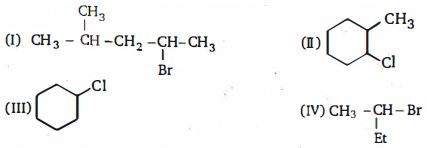
Among the given halides, which one will give same product in both $S_{N^1}$ and $S_{N^2}$ reactions
Some reactions of amines are given. Which one is not correct ?
The alkene that will give the same product with $HBr$ in the absence as well as in the presence of peroxide is
Which conformation of ethane has the lowest potential energy ?
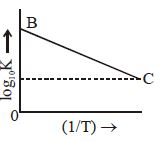
Following figure shows a graph in $log_{10}K$ vs $\frac{1}{T}$ where $K$ is rate constant and $T$ is temperature. The straight line $BC$ has slope, $tan\,\theta  = -\frac{1}{2.303}$ and an intercept of $5$ on $Y-$ axis. Thus $E_a$, the energy of activation is ....... $cal$
Given below are two statements : one is labelled as Assertion $(A)$ and the other is labelled as Reason $(R)$

Assertion $(A)$ : The first ionization enthalpy of $3 d$ series elements is more than that of group $2$ metals

Reason $(R)$ : In $3d$ series of elements successive filling of d-orbitals takes place.

In the light of the above statements, choose the correct answer from the options given below :

$CH_3OH$ and $C_2H_5OH$ may be distinguished chemically