MCQ
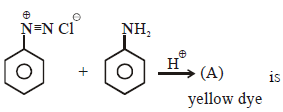
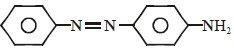
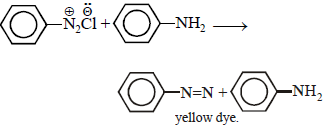
In the following Reaction the product $(A)$
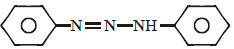
  • A

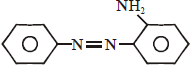
  • B

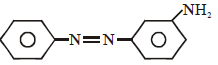
  • C


Answer

Correct option: D.

d

Need a full question paper?

Generate a complete, print-ready paper with questions like this in minutes — across 16+ boards, with answer keys.

Start Generating Free

Similar questions

An ideal solution was obtained by mixing methanol and ethanol. If the partial vapour pressure of methanol and ethanol are $2.619\,kPa$ and $4.556\,kPa$ respectively, the composition of the vapour (in terms of mole fraction) will be
Which is symmetrical ?
Which of the following statement about the reactivity of $1-$ chloro apocamphane toward $AgNO_3$ is true.
Hybridisation of the carbon atom of carbonyl group is :
The energies of activation for forward and reverse reactions for $A_2 + B_2 \rightleftharpoons  2AB$ are $180\, kJ\, mol^{-1}$ and $200 \,kJ\, mol^{-1}$  respectively. The presence of a catalyst lowers the activation energy of both (forward and reverse) reactions by $100\, kJ\,mol^{-1}.$ The enthalpy change of the reaction $(A_2 + B_2 \rightarrow 2AB)$ in the presence of a catalyst will be ( in $kJ\, mol^{-1}$)
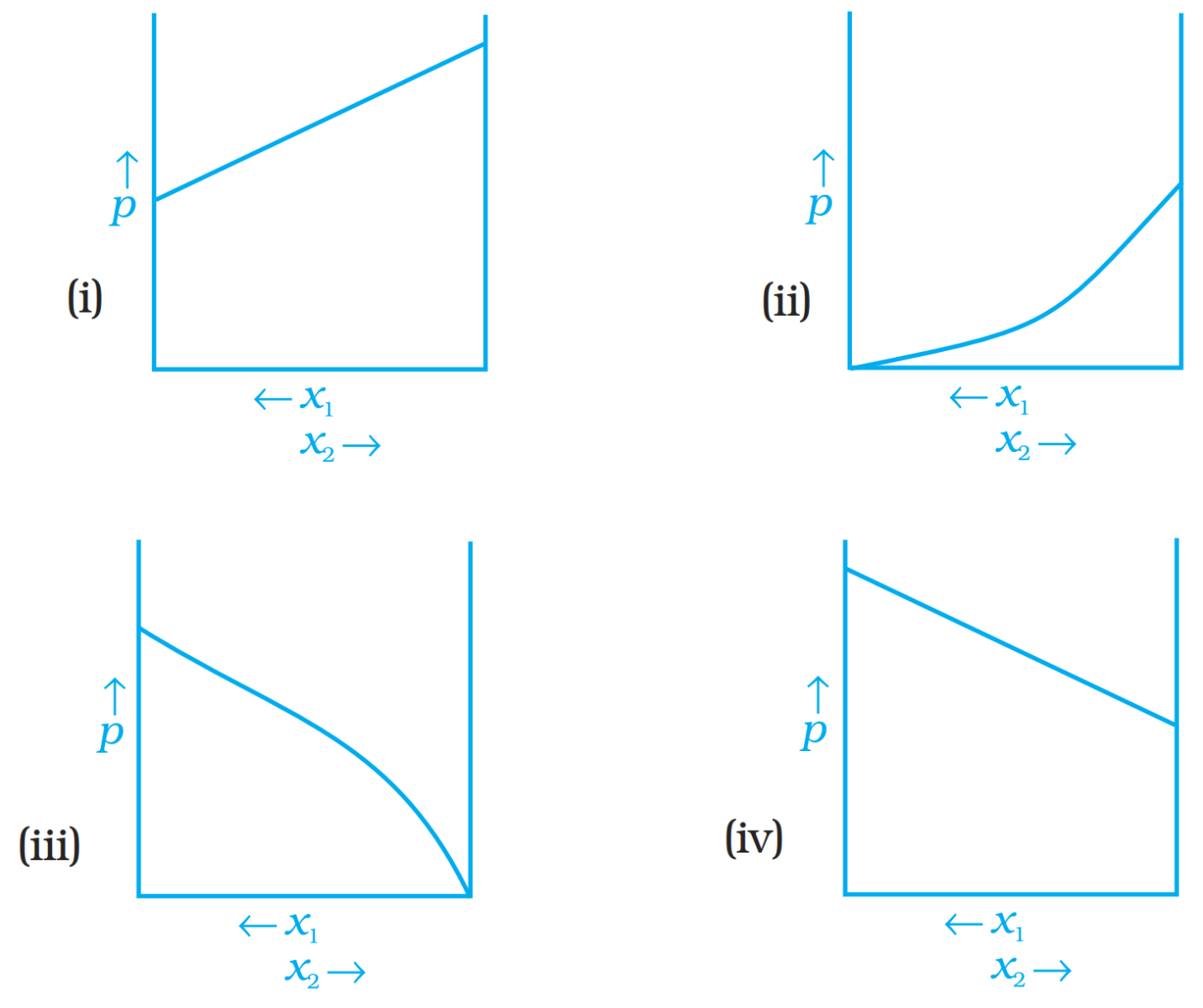
For a binary ideal liquid solution, the variation in total vapour pressure versus composition of solution is given by which of the curves?

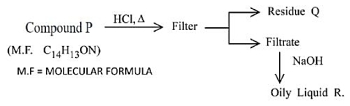
Compound $P$ is neutral. $Q$ gives effervescence with $NaHCO _3$ while $R$ reacts with Hinsbergs reagent to give solid soluble in $NaOH$. Compound $P$ is
The incorrect order indicated against the rate of reaction is Rate Order

$A+B\xrightarrow{K}C$

Rate                        Order

At $27\,^oC$, for the reaction, $N_2O_{4(g)} \to  2NO_{2(g)}$ , rate of reaction is $6\times10^{-3}\, atm\, min^{-1}$. Find rate of same reaction in terms of $mol\, L^{-1}\, min^{-1}$ .
The colligative properties of a solution depend on