MCQ
In the gas equation $\text{PV = RT, V}$ is the volume of:
  • $1$ mol of gas
  • B
    $1g$ of gas
  • C
    Gas
  • D
    $1$ litre of gas

Answer

Correct option: A.
$1$ mol of gas
For an Ideal Gas, $\text{PV = nRT}$
Here $V$ is the volume of $n$ moles of gas.
Thus for $\text{PV = (1)RT, V}$ is the volume of $1$ mol of gas.

Need a full question paper?

Generate a complete, print-ready paper with questions like this in minutes — across 16+ boards, with answer keys.
Start Generating Free

Similar questions

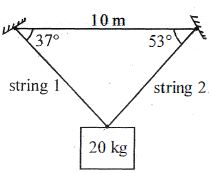
A mass of $20\  kg$ is hanging with support of two strings of same linear mass density. Now pulses are generated in both strings at same time near the joint at mass. Ratio of time, taken by a pulse travel through string $1$ to that taken by pulse on string $2$ is
The equation of a projectile is $y=a x-b x^2$. Its horizontal range is ......
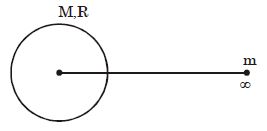
A particle of mass $m$ is released from infinity and it move towards a big solid sphere made of a jelly like material. Neglecting the resistance offered by material of sphere, find the velocity of the particle when it crosses the centre of the sphere
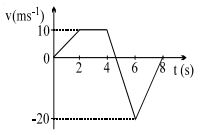
The figure shows a velocity-time graph of a particle moving along a straight line  The correct displacement-time graph of the particle is shown as
At nodes in stationary waves
The ratio of the $K.E.$ required to be given to the satellite to escape earth's gravitational field to the $K.E.$ required to be given so that the satellite moves in a circular orbit just above earth atmosphere is
Given below are two statements :

Statement $(I)$ : The mean free path of gas molecules is inversely proportional to square of molecular diameter.

Statement $(II)$ : Average kinetic energy of gas molecules is directly proportional to absolute temperature of gas.

In the light of the above statements, choose the correct answer from the option given below:

Two projectiles $A$ and $B$ are thrown with the same speed but angles are $40^{\circ}$ and $50^{\circ}$ with the horizontal. Then
Two point masses $m$ and $4 m$ are separated by a distance $d$ on a line. A third point mass $m_0$ is to be placed at a point on the line such that the net gravitational force on it is zero. The distance of that point from the $m$ mass is ..............
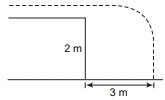
Water is flowing from a horizontal pipe fixed at a height of $2\,m$ from the ground. If it falls at a horizontal distance of $3\,m$ as shown in figure, the speed of water when it leaves the pipe is $............\,ms^{-1}$ (take $g=9.8\,ms ^{-2}$ )