MCQ
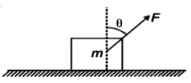
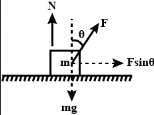
In the given arrangement, the normal force applied by block on the ground is
  • A
    $m g$
  • $m g-F \cos \theta$
  • C
    $m g+F \cos \theta$
  • D
    $F \cos \theta$

Answer

Correct option: B.
$m g-F \cos \theta$
b
(b)

$N + F \cos \theta=m g$

$N = mg - F \cos \theta$

Hence,option $(B)$ is correct answer.
Need a full question paper?

Generate a complete, print-ready paper with questions like this in minutes — across 16+ boards, with answer keys.
Start Generating Free

Similar questions

If at any point on the path of a projectile its velocity is $u$ at inclination $\alpha$ then it will  move at right angles to former direction after time
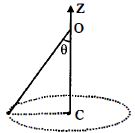
A conical pendulum of length $1\,m$ makes an angle $\theta \, = 45^o$ w.r.t. $Z-$ axis and moves in a circle in the $XY$ plane.The radius of the circle is $0.4\, m$ and its centre is vertically below $O$. The speed of the pendulum, in its circular path, will be ..... $m/s$ (Take $g\, = 10\, ms^{-2}$)
An aeroplane is flying with a uniform speed of $100\, m/s$ along a circular path of radius $100 m$. the angular speed of the aeroplane will be ......... $rad/sec$
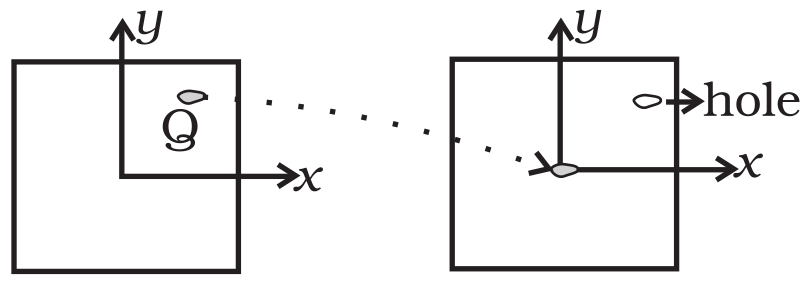
A uniform square plate has a small piece Q of an irregular shape removed and glued to the centre of the plate leaving a hole behind. The moment of inertia about the z-axis is then:

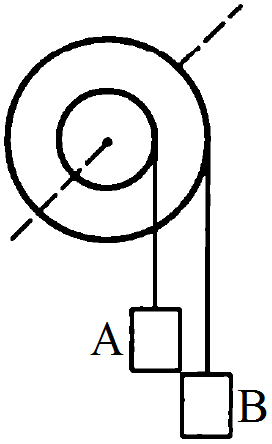
Figure shows a small wheel fixed coaxially on a bigger one of double the radius. The system rotates about the common axis. The strings supporting A and B do not slip on the wheels. If x and y be the distance travelled by A and B in the same time interval, then:

  1. x = 2y
  2. x = y
  3. y = 2x
  4. None of these.
A disc of mass $1 \,kg$ and radius $0.1 \,m$ is rotating with angular velocity $20 \,rad / s$. What is angular velocity (in $rad/s$) if a mass of $0.5 \,kg$ is put on the circumference of the disc?
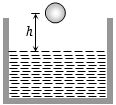
A ball of radius $r $ and density $\rho$ falls freely under gravity through a distance $h$ before entering water. Velocity of ball does not change even on entering water. If viscosity of water is $\eta$, the value of $h$ is given by
An object with a mass $10 \,kg$ moves at a constant velocity of $10 \,m/sec$. A constant force then acts for $4\, second$ on the object and gives it a speed of $2\, m/sec$ in opposite direction. The acceleration produced in it, is ........ $m/{\sec ^2}$
A flag is mounted on a car moving due North with velocity of $20 \,\,km/hr$ Strong winds are blowing due East with velocity of $20\,\,km/hr$. The flag will point in direction
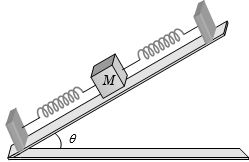
On a smooth inclined plane, a body of mass $M$ is attached between two springs. The other ends of the springs are fixed to firm supports. If each spring has force constant $K$, the period of oscillation of the body (assuming the springs as massless) is