Question
In the given below activity, on heating the solution, water evaporates, and we get back the ink dye in the watch glass. The different substance has a different boiling point. We use this property to separate the components of the mixture. Here, the boiling point of ink is much higher than that of water. On heating the ink solution, water evaporates while ink dye remains in the china dish.
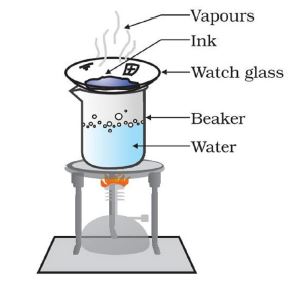
$(i)$ Name the process shown in the diagram.
$(a)$ Boiling $(b)$ Filtration $(c)$ Crystallisation $(d)$ Distillation
$(ii)$ Which type of substance can be separated by this method ?
$(a)$ Any solvent from its non-volatile solute.
$(b)$ The volatile solvent from its non-volatile solute.
$(c)$ The non-volatile solvent from its non-volatile solute.
$(d)$ The volatile solvent from its volatile solute.
$(iii)$ What can we interpret about the nature of ink ?
$(a)$ We cannot separate components of ink $(b)$ Ink is not a mixture
$(c)$ Ink is pure substance $(d)$ Ink is a mixture of dyes in water.
$(iv)$ Name the component which gets evaporated.
$(a)$ Heating leads to the evaporation of water.
$(b)$ Heating leads to the evaporation of dyes.
$(c)$ Heating leads to the filtration of water.
$(d)$ Heating leads to the distillation of dyes.
$(v)$ Define the process shown in the diagram
$(a)$ It is the process of conversion of a liquid into its vapours.
$(b)$ It is a process of separating insoluble component by filtering the solution
$(c)$ It is a process that separates a pure solid in the form of its crystals
$(d)$ It is a technique to separate two miscible liquids

Answer

self study

Need a full question paper?

Generate a complete, print-ready paper with questions like this in minutes — across 16+ boards, with answer keys.

Start Generating Free

Similar questions

‘scientific’ name for organisms in the same manner that chemical symbols and formulae for various substances are used in the world. The scientific name for an organism is thus unique and can be used to identify it anywhere in the world.The system of scientific naming or nomenclature we use today was introduced by Carolus Linnaeus in the eighteenth century. The scientific name of an organism isthe process of classification which puts it along with the organisms it is most related to. But when we actually name the species, we do not list out the whole hierarchy of groups it belongs to. Instead, we limit ourselves to writing the name of the genus and species of that particular organism. World over, it has been agreed that both these names will be used in Latin forms.
Certain conventions are followed while writing the scientific names:
(1) The name of the genus begins with a capital letter.
(2) The name of the species begins with a small letter.
(3) When printed, the scientific name is given in italics.
(4) When written by hand, the genus name and the species name have to be underlined separately.
(1) The system of scientific naming or nomenclature we use today was introduced by
$(a)$ Carolus Linnaeus
$(b)$ Ernst Haeckel
$(c)$ Robert Whittaker
$(d)$ Carl Woese
(2) When scientific name is printed is given in
$(a)$ Bold
$(b)$ Italics
$(c)$ Italic in lowercase
$(d)$ Bold in uppercase
(3) Identify the correct statement
Statement $1$ – Name of the genus begins with a capital letter.
Statement $2$ – Name of the species begins with a small letter.
Statement $3$ –Name of the genus begins with a small letter
Statement $4$ –When printed, the scientific name is given in bold
$(a)$ Both $1$ & $3$
$(b)$ Both $3$ & $4$
$(c)$ Both $1$ & $2$
$(d)$ All of the above
(4) Why is there a need for systematic naming of living organisms?
(5) Which rules and conventions are need to be followed while writing the scientific names?
Dalton’s atomic theory suggested that the atom was indivisible and indestructible. But the discovery of two fundamental particles (electrons and protons) inside the atom, led to the failure of this aspect of Dalton’s atomic theory. It was then considered necessary to know how electrons and protons are arranged within an atom. For explaining this, many scientists proposed various atomic models. $J.J.$ Thomson was the first one to propose a model for the structure of an atom.$J.J.$ Thomson $(1856- 1940)$ was a British physicist, He was awarded the Nobel Prize in Physics for his work on the discovery of electrons. Thomson proposed the model of an atom to be similar to that of a Christmas pudding. The electrons, in a sphere of positive charge. We can also think of a watermelon, the positive charge in the atom is spread all over like the red edible part of the watermelon, while the electrons are studded in the positively charged sphere, like the seeds in the watermelon. Thomson proposed that: An atom consists of a positively charged sphere and the electrons are embedded in it. The negative and positive charges are equal in magnitude. So, the atom as a whole is electrically neutral.
(1) Identify the correct statement
Statement $1$ – Dalton’s atomic theory suggested that the atom was indivisible and indestructible.
Statement $2$ – Electrons and protons are present inside the atom.
Statement $3$ – $J.J.$ Thomson was the first one to propose a model for the structure of an atom.
Statement $4$ – Protons are positively charged particle.
$(a)$ Only $2$
$(b)$ Both $3$ & $4$
$(c)$ Both $1$ & $2$
$(d)$ All of the above
(2) According to Dalton’s Atomic Theory, matter consists of indivisible _______
$(a)$ Molecules
$(b)$ Atoms
$(c)$ Ions
$(d)$ Mixtures
(3) Who was the first to propose atomic theory?
$(a)$ $J.J.$ Thomson
$(b)$ John Dalton
$(c)$ $E.$ Rutherford
$(d)$ Neilsbhore
(4) “Atom is indivisible and indestructible” why this aspect of Dalton’s atomic theory leds to the failure?
(5) Explain the J.J. Thomson’s model for the structure of an atom?
Read the following text carefully and answer the questions that follow:
Animal tissue has various types of epithelial tissue, connective tissue, muscular tissue, and nervous tissue and of tissue one of them is the connective tissue which consists of blood, bone, cartilage. Blood is the fluid matrix called plasma in which red blood cells, white blood cells, and platelet are suspended while bone form the framework that supports the body it also anchors the muscle and supports the main organ of the body. Two bones are connected by a ligament. cartilage is a solid matrix composed of sugar and protein.
i. Name the tissue which connects muscle to a bone.
ii. Matrix of bone cells are composed of
iii. Two bones are connected by ligament how muscle connects to the bone?
OR
Where the cartilage is found in the human body?
Newton’s first law of motion states that a body at rest will remain at rest position only and a body which is in motion continues to be in motion unless otherwise they are acted upon by an external force. In other words, all objects resist a changein their state of motion. In a qualitative way, the tendency of undisturbed objects to stayat rest or to keep moving with the same velocity is called inertia. This is why, the firstlaw of motion is also known as the law of inertia. Answer the following questions.
(i) The first law of motion is also known as
$(a)$law of inertia/p>
$(b)$law of thermodynamics
$(c)$both $a$ and $b$
$(d)$none of these
(ii) If no external force acts on object which is at rest. it will
$(a)$remain at rest
$(b)$start to move
$(c)$both a and b can possible
$(d)$none of these
(iii) If no external force acts on moving object. it will
$(a)$stop moving
$(b)$continue to move with same speed in same direction
$(c)$changes its direction of motion
$(d)$none of these
(iv) State Newton’s first law of motion.
(v) why Newton’s first law of motion is called law of inertia
A moving object can do work. An object moving faster can do more work than an identical object moving relatively slow. A moving bullet, blowing wind, a rotating wheel, a speeding stone can do work. How does a bullet pierce the target? How does the wind move the blades of a windmill? Objects in motion possess energy. We call this energy kinetic energy.Thus, the kinetic energy possessed by an object of mass, m and moving with a uniform velocity, $v$ is
$\mathrm{KE}=1 / 2 \times \mathrm{mv}^2$
The energy possessed by an object is thus measured in terms of its capacity of doing work. The unit of energy is, therefore, the same as that of work, that is, joule $(J)$.
(i) Energy possessed by body which is in motion is called
$(a)$ Potential energy
$(b)$ Kinetic energy
$(c)$ Nuclear energy
$(d)$ None of these
(ii) Which of the following has same unit?
$(a)$ Potential energy and Force
$(b)$ Kinetic energy and work
$(c)$ Both $a$ and $b$
$(d)$ None of these
(iii) Kinetic energy depends
$(a)$ Inversely on velocity of body
$(b)$ Directly on square of velocity of body
$(c)$ Directly on velocity of body
$(d)$ None of these
(iv) Define kinetic energy of body. Give its SI unit
(v) Is kinetic energy scalar or vector? Justify your answer
Archimedes’ principle, stated as follows: When a body is immersed fully or partiallyin a fluid, it experiences an upward force thatis equal to the weight of the fluid displacedby it. The upward force is known as up thrust or buoyant force. In fact, all objects experience a force of buoyancy when they are immersed in a fluid. The magnitude of this buoyant force depends on the density of the fluid.Objects having density less than that of the liquid in which they are immersed float on the surface of the liquid. If the density of the object is more than the density of the liquid in which it is immersed then it sinks in the liquid. Hence body will float or sink depends upon difference between density of body and fluid.
(i)The up thrust of the body is equal to the
$(a)$ Mass of liquid
$(b)$ Weight of liquid
$(c)$ Weight of liquid displaced by body
$(d)$ None of these
(ii) If the density of the object is more than the density of the liquid in which it is immersed then
$(a)$ It sinks in liquid
$(b)$ It floats on liquid
$(c)$ It comes out of liquid
$(d)$ None of these
(iii) When anybody immersed in liquid it experience a force called as
$(a)$ Gravitational force
$(b)$ Buoyancy force
$(c)$ Nuclear force
$(d)$ None of these
(iv) State Archimedes’ principle.
(v) Why does cube of plastic released deep down under the water come up to surface of water?

 
Sound bounces off a solid or a liquid like a rubber ball bounces off a wall. Like light, soundgets reflected at the surface of a solid or liquid and follows the same laws of reflection. The directions in which the sound is incident and is reflected make equal angles with the normal to the reflecting surface at the point of incidence, and the three are in the same plane. If we clap near a suitable reflecting object such as a tall building or a mountain, we will hear the same sound again a little later. This sound which we hear is called an echo. The sensation of sound persists in our brain for about $0.1\ s$. To hear a distinct echo the time interval between the original sound and the reflected one must be at least $0.1\ s$. Hence, for hearingdistinct echoes, the minimum distance of theobstacle from the source of sound must be $17.2\ m$. Thisdistance will change with the temperature ofair. Another phenomenon of reflection of sound is reverberation.A sound created in a big hall will persist byrepeated reflection from the walls until it isreduced to a value where it is no longeraudible. The repeated reflection that resultsin this persistence of sound is called reverberation. Excessive reverberation is highly undesirable.
(i) Which of the following is true related to reflection of sound?
$(a)$ Directions in which the sound is incident and is reflected make equal angles with the normal to the reflecting surface at the point of incidence.
$(b)$ Incident wave reflected wave and normal lies in same plane
$(c)$ Both a and b are true.
$(d)$ None of these
(ii)For hearing distinct echoes, the minimum distance of the obstacle from the source of sound must be
$(a)$ $10m$
$(b)$ $20m$
$(c)$ $17.2m$
$(d)$ None of these
(iii) Excessive reverberation is
$(a)$ Desirable phenomenon
$(b)$ Undesirable phenomenon
$(c)$ Does not exist
$(d)$ None of these
(iv) A person makes sound near a obstacle and heard the echo after 1 s. What is the distance of the obstacle from the person if the speed of the sound, v is taken as 346 m/s?
(v) State law of reflection of sound.
There are three states of matter – solid, liquid and gas.
Solids have a definite shape, distinct boundaries and fixed volumes, that is, have negligible compressibility. Solids have a tendency to maintain their shape when subjected to outside force. Solids may break under force but it is difficult to change their shape, so they are rigid.
Liquids have no fixed shape but have a fixed volume. They take up the shape of the container in which they are kept. Liquids flow and change shape, so they are not rigid but can be called fluid.
Gas as has indefinite shape, no fixed volume. Gas gets the shape and volume of container.
Gas has very low density hence are light. Gas can flow easily and hence are called fluid.
$i.)$ Which of the following state of matter takes shape of container in which it is filled?
$a.)$ Solid
$b.)$ Liquid
$c.)$ Gas
$d.)$ Both $b$ and $c$
$ii.)$ Distance between particles of matter least in
$a.)$ Solid
$b.)$ Liquid
$c.)$ Gas
$d.)$ None of these
$iii.)$ Compressibility is least in case of
$a.)$ Solid
$b.)$ Liquid
$c.)$ Gas
$d.)$ None of these
$iv.)$ Give properties of solids.
$v.)$ Give properties of Gases.
Three mixtures $A, B$ and $C$ are obtained by stirring three different solids in water taken in separate beakers. When mixture $A$ is allowed to stand for some time, then its particles settle at the bottom of the beaker. When a beam of light is passed through mixture $A$ in a dark room, the path of light becomes visible when observed from the side of the beaker. When mixture $B$ is allowed to stand for a considerable time, even then its particles do not settle down. Mixture $B$, however, scatters the beam of light just like mixture $A$. The particles of mixture $C$ do not settle down on keeping and it also does not scatter a beam of light passing through it.
  1. What are the mixtures like $A$ known as?
  2. What are the mixtures like $B$ known as?
  3. What are the mixtures like $C$ known as?
  4. Name the phenomenon exhibited by $A$ and $B$ which occurs on passing a beam of light through them.
  5. Name one mixture each which is like $(i) A (ii) B$, and $(iii) C.$
The third law of motion states that when one object exerts a force on another object, the second object instantaneously exerts a force back on the first. These two forces are always equal in magnitude but opposite in direction. These forces act on different objects and neveron the same object. It is important to note that even though the action and reaction forces are always equal in magnitude; these forces may not produce accelerations of equal magnitudes, this is because each force acts on a different object that may have a different mass.The two opposing forces are also known as action and reaction forces. Answer the following questions.
(i) Action reaction forces are always
$(a)$ Equal and in same direction
$(b)$ Equal and in opposite direction
$(c)$ Unequal and in same direction
$(d)$ None of the above
(ii) Which of the following is correct about action reaction forces?
$(a)$ They act on different objects
$(b)$ They are equal in magnitude and opposite in direction
$(c)$ Both forces acted on different object simultaneously
$(d)$ All the above
(iii) State third law of motion
(iv) Give 5 examples of third law of motion
(v) Even though the action and reaction forces are always equal in magnitude; these forces may not produce accelerations of equal magnitudes. Give your justification on this statement