Question
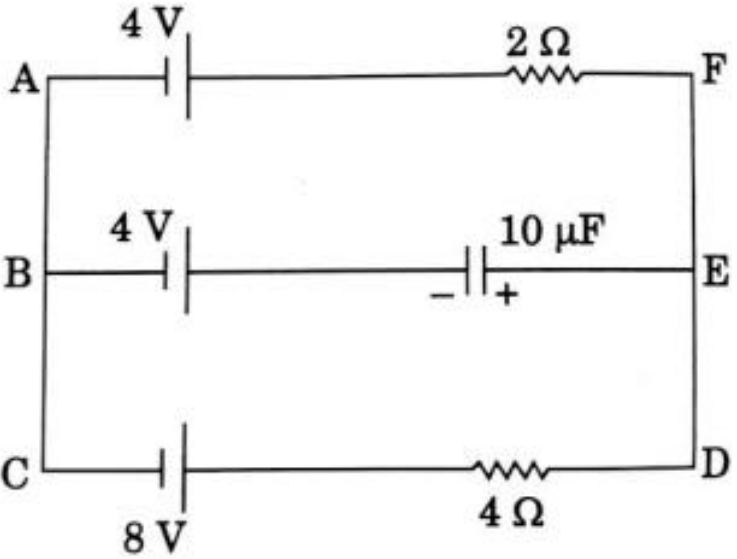
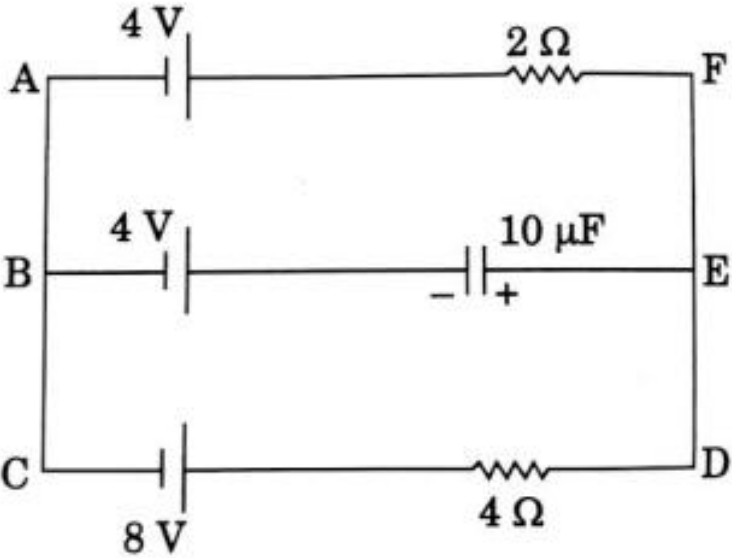
In the given circuit, with steady current, calculate the potential drop across the capacitor and the charge stored in it.
Answer


In loop ACDFA 
$I=\bigg[\frac{8-4}{4+2}\bigg]\text{A}=\frac{2}{3}\text{A}$
$V_{AF}=V_{BE}$
$\Rightarrow\text{ }4-2\times\frac{2}{3}=4-V_c$
$\Rightarrow\text{ }V_c=\frac{4}{3}\text{V}$
$\text{Charge}, \text{Q}=CV_c$ 
$\text{Q}=(10{\mu}\text{F}\times\frac{4}{3})$
$=13.33 \text{ }{\mu}\text{C}$

Need a full question paper?

Generate a complete, print-ready paper with questions like this in minutes — across 16+ boards, with answer keys.
Start Generating Free

Similar questions

From the erelation $R=R_0 A^{1 / 3}$, where $R_o$ is a constant and $A$ is the mass number of nucleus, show that the nuclear matter density is nearly constant (i.e. independent of A ).
What are eddy currents? How are these produced? In what sense are eddy currents considered undesirable in a transformer and how are these reduced in such a device?
When the base current in a transistor is changed from $30\mu\text{A}$ to $80\mu\text{A},$ the collector current is changed from 1.0mA to 3.5mA. Find the current gain $\beta.$
How does Maxwell modify Ampere's circuital law? Explain.
Suppose we have $12$ protons and $12$ neutrons. We can assemble them to form either $a :uMg$ nucleus or two $12C$ nuclei. In which of the two cases more energy will be liberated$?$
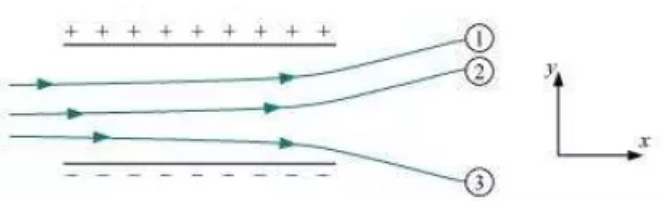
Figure 1.33 shows tracks of three charged particles in a uniform electrostatic field. Give the signs of the three charges. Which particle has the highest charge to mass ratio?
Explain internal reflection and total internal reflection and also derive the necessary formula for it.
How is a wavefront defined? Using Huygen’s construction draw a figure showing the propagation of a plane wave refracting at a plane surface separating two media. Hence verify Snell’s law of refraction.
Two narrow slits emitting iight in phase are separated by a distance of $1.0\ cm.$ The wavelength of the light is $5.0 \times 10^{-7}m.$ The interference pattern is observed on a screen placed at a distance of $1.0m.$
  1. Find the separation between the consecutive maxima. Can you expect to distinguish between these maxima?
  2. Find the separation between the sources which will give a separation of $1.0\ mm$ between the consecutive maxima.
Find the Q-value and the kinetic energy of the emitted α-particle in the $\alpha $-decay of
  1.  $^{226}_{88}\text{Ra}$ and  
  2. $^{220}_{86}\text{Rn}.$
Given
$\text{m}(^{226}_{88}\text{Ra})=226.02540\text{ u}.$ $\text{m}(^{222}_{86}\text{Rn})=222.01750\text{ u}.$
$\text{m}(^{222}_{86}\text{Rn})=220.01137\text{ u}.$ $\text{m}(^{216}_{84}\text{Po})=216.00189\text{ u}.$