Question
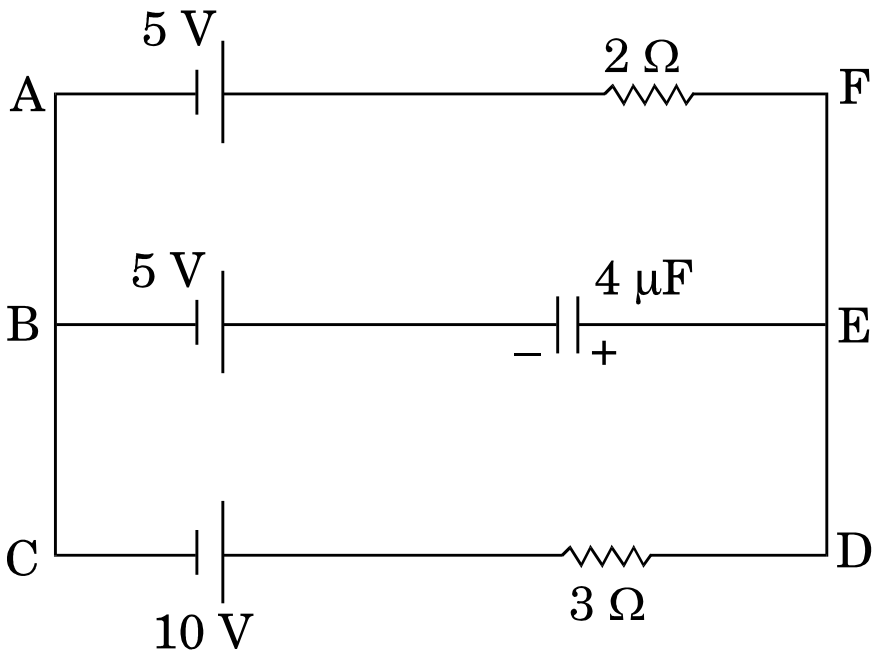
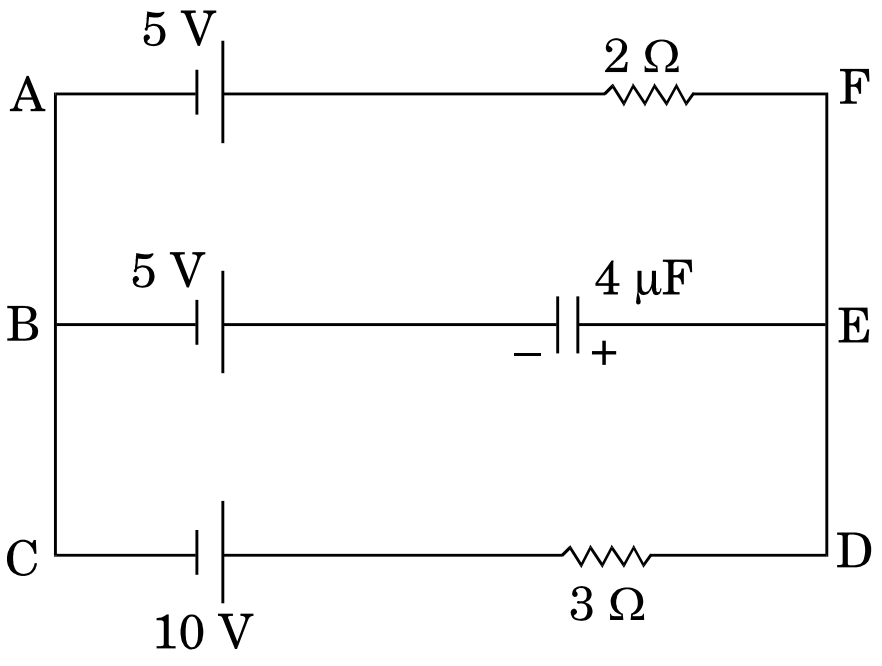
In the given circuit, with steady current, calculate the potential drop across the capacitor in terms of V.
Answer


In steady state branch BE is eliminated 
$ \text{I}=\frac{10{\text{V}}-5\text{V}}{(3+2){\Omega}}\text{A}$
$=\text{1A}$
For loop EBCDE
$-v_c{-5+10-3\times1}=0$
$-{\text{V}}_c+10-8=0$
$\therefore{\text{V}_c}=2\text{ }\text{volt}$

Need a full question paper?

Generate a complete, print-ready paper with questions like this in minutes — across 16+ boards, with answer keys.

Start Generating Free

Similar questions

What is Peltier effect ?
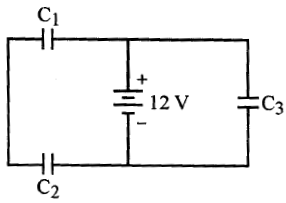
Three identical capacitors $C_1, C_2$ and $C_3$ of capacitance $6 \mu F$ each are connected to a $12 V$ battery as shown.
Find:
  1. charge on each capacitor.
  2. equivalent capacitance of the network.
  3. energy stored in the network of capacitors.
The energy flux of sunlight reaching the surface of the earth is $1.388 \times 10^3 W/m^2.$ How many photons $($nearly$)$ per square metre are incident on the Earth per second? Assume that the photons in the sunlight have an average wavelength of $550\ nm.$
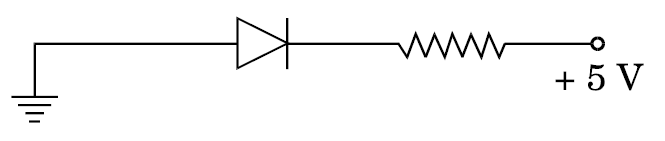
  1. In the following diagram, is the junction diode forward biased or reverse biased?
  1. Draw the circuit diagram of a full wave rectifier and state how it works.
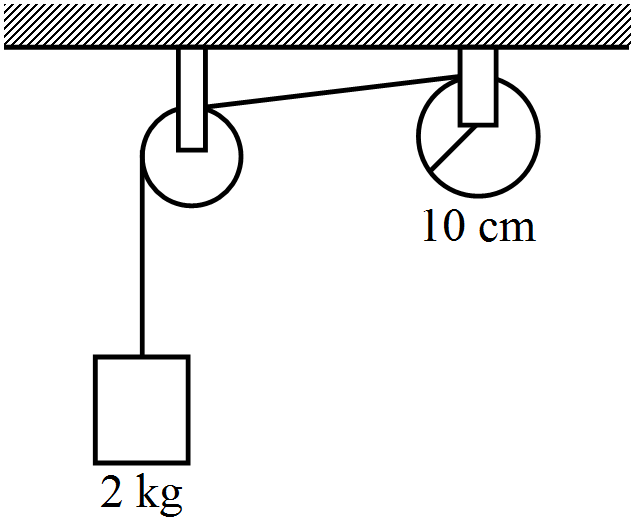
A string is wrapped on a wheel of moment of inertia $0.20\ kg-m^2$ and radius $10\ cm$ and goes through a light pulley to support a block of mass $2.0\ kg$ as shown in figure. Find the acceleration of the block.
A wire of length 1m and radius 0.1mm has a resistance of $100\Omega.$ Find the resistivity of the material.
A traffic policeman standing on a road sounds a whistle emitting the main frequency of $2.00\ kHz$. What could be the appparent frequency heard by a scoote$r-$driver approaching the policeman at a speed of $36.0\ km/h?$ Speed of sound in air $= 340\ m/s.$
Explain principle, construction and working of optical fibre.
Suppose the glass of the previous problem is covered by a jar and the air inside the jar is completely pumped out.
  1. What will be the answers to the problem?
  2. Show that the answers do not change if a glass of different shape is used provided the height, the bottom area and the volume are unchanged.
A steel rod is rigidly clamped at its two ends. The rod is under zero tension at $20^\circ C$. If the temperature rises to $100^\circ C,$ what force will the rod exert on one of the clampa? Area of Cross section of the rod $= 2.00\ mm^2$. Coefficient of linear expansion of steel $12.0 \times 10^{-6^\circ} C^{-1}$ and Young's modulus of steel $= 2.00 \times 10^{11}N m^{-2}.$