Question
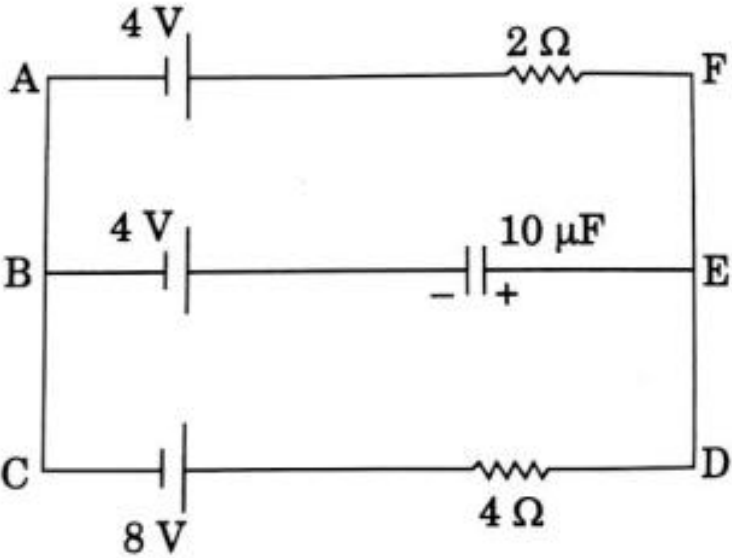
In the given circuit, with steady current, calculate the potential drop across the capacitor and the charge stored in it.
Answer


In loop ACDFA 

$I=\bigg[\frac{8-4}{4+2}\bigg]\text{A}=\frac{2}{3}\text{A}$

$V_{AF}=V_{BE}$

$\Rightarrow\text{ }4-2\times\frac{2}{3}=4-V_c$

$\Rightarrow\text{ }V_c=\frac{4}{3}\text{V}$

$\text{Charge}, \text{Q}=CV_c$ 

$\text{Q}=(10{\mu}\text{F}\times\frac{4}{3})$

$=13.33 \text{ }{\mu}\text{C}$

Need a full question paper?

Generate a complete, print-ready paper with questions like this in minutes — across 16+ boards, with answer keys.
Start Generating Free

Similar questions

A metre stick is held vertically with one end on a rough horizontal floor. It is gently allowed to fall on the floor. Assuming that the end at the floor does not slip, find the angular speed of the rod when it hits the floor.
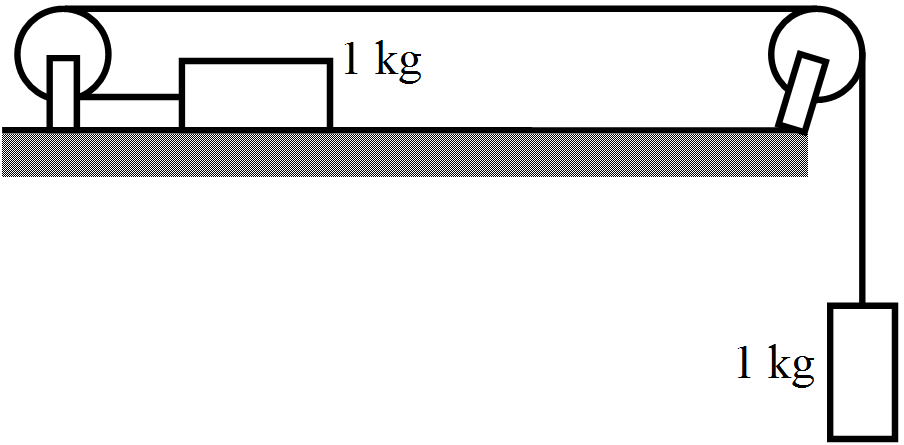
Calculate the tension in the string shown in figure. The pulley and the string are light and all surfaces are frictionless. Take g = 10m/s2.

Is Huygen’s principle valid for longitudunal sound waves?
A 60μF capacitor is connected to a 110V, 60Hz ac supply. Determine the rms value of the current in the circuit.
The wires which connect the battery of an automobile to its starting motor carry a current of 300 A (for a short time). What is the force per unit length between the wires if they are 70 cm long and 1.5 cm apart? Is the force attractive or repulsive?
A small telescope has an objective lens of focal length 140 cm and an eyepiece of focal length 5.0 cm. What is the magnifying power of the telescope for viewing distant objects when,
  1. the telescope is in normal adjustment (i.e., when the final image is at infinity)?
  2. the final image is formed at the least distance of distinct vision (25 cm)?
Can an electromagnetic wave be polarised?
A 2.00m long rope, having a mass of 80g, is fixed at one end and is tied to a light string at the other end. The tension in the string is 256N.
  1. Find the frequencies of the fundamental and the first two overtones.
  2. Find the wavelength in the fundamental and the first two overtones.
Consider the situation of the previous problem. Suppose the production of the radioactive isotope starts at t = 0. Find the number of active nuclei at time t.
In a typical fission reaction, the nucleus is split into two middle-weight nuclei of unequal masses. Which of the two (heavier or lighter) has greater kinetic energy? Greater linear momentum?