MCQ
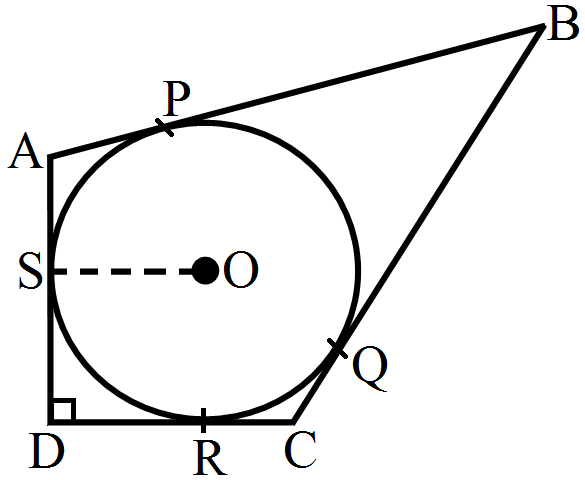
In the given figure, a circle is inscribed in a quadrilateral $\text{ABCD}$ touching its sides $\text{AB, BC, CD}$ and $\text{AD}$ at $\text{P, Q, R}$ and $S$ respectively. If the radius of the circle is $10\ cm, \text{BC} = 38\ cm, \text{PB} = 27\ cm$ and $\text{AD} \perp \text{CD}$ then the length of $\text{CD}$ is:
  • A
    $11\ cm$
  • B
    $15\ cm$
  • C
    $20\ cm$
  • $21\ cm$

Answer

Correct option: D.
$21\ cm$
We know that tangles from an external point to the circle are equal.
$\text{BQ = PB} = 27\ cm$
So, $\text{CQ = BC - BQ} = 38 - 27 = 11\ cm$
$\Rightarrow \text{CR = CQ} = 11\ cm$
In quad. $\text{SORD,}$
$\angle\text{SDR}=90^\circ....(\therefore\text{AD}\perp\text{CD})$
$\Rightarrow\angle\text{OSD}=\angle\text{ORD}=90^\circ$
Also, $\text{OS = OR}$ and $\text{SD = SR}$
So, quad. $\text{SORD}$ is a square.
Thus, $\text{DR = SO} = 10\ cm$
Hence, $\text{CD = DR + CR} = 10 + 11 = 21cm.$

Need a full question paper?

Generate a complete, print-ready paper with questions like this in minutes — across 16+ boards, with answer keys.

Start Generating Free

Similar questions

The value of k for which the system, of equations has infinite number of solutions, is:
$2x + 3y = 5$
$4x + ky = 10$
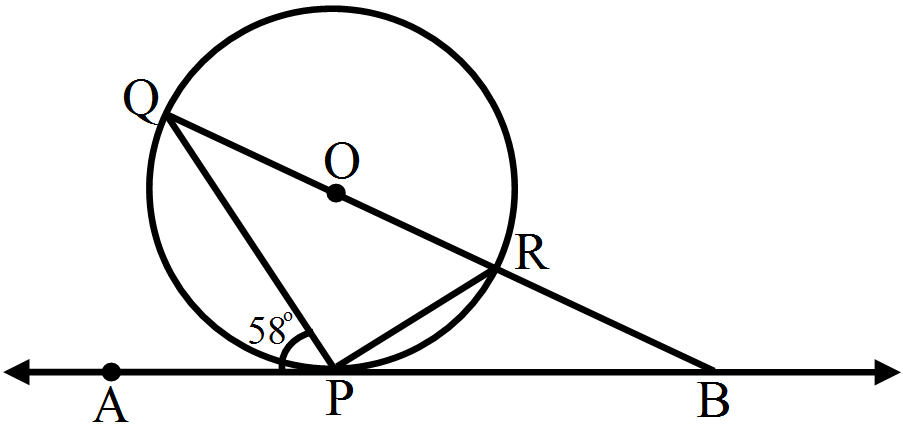
In the given figure, $O$ is the centre of the circle. $\text{AB}$ is the tangent to the circle at the point $P$. If $\angle\text{APQ}=58^\circ$ then the measure of $\angle\text{PQB}$ is:
If $\frac{1}{\text{x}}+\frac{2}{\text{y}}=4$ and $\frac{3}{\text{y}}+\frac{1}{\text{x}}=11$ then:
Mark the correct alternative in the following:
It the sums of n terms of two arithmetic progressions are in the ratio $\frac{3\text{n}+5}{5\text{n}-7}$, then their $n^{th}$ terms are in the ratio.
If $\text{2x}=\sec\text{A}$ and $\frac{2}{\text{x}}=\tan\text{A}$ then $2\Big(\text{x}^2-\frac{1}{\text{x}^2}\Big)=?$
If the radius of a sphere becomes $3$ times, then its volume will become:
Two circles intersect each other such that each circle passes through the centre of the other. If the distance between their centres is 12, what is the radius of each circle ?
Consider the frequency distribution of the heights of 60 students of a class:
Height $($in $cm)$ No. of Students Cumulative Frequency
$150-155$ $16$ $16$
$155-160$ $12$ $28$
$160-165$ $9$ $37$
$165-170$ $7$ $44$
$170-175$ $10$ $54$
$175-180$ $6$ $60$
The sum of the lower limit of the modal class and the upper limit of the median class is:
If $\alpha$ and $\beta$ are the zero of $x^2 + 5x + 8$, then the value of $(\alpha+\beta)$ is:
The diameters of two circular ends of a bucket are $44\ cm$ and $24\ cm,$ and the height of the bucket is $35\ cm.$ The capacity of the bucket is: