Question
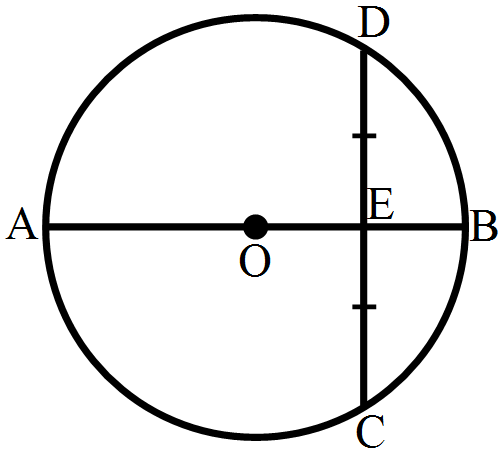
In the given figure, a circle with centre $O$ is given in which a diameter $A B$ bisects the chord $C D$ at a point $E$ such that $C E=E D=8 cm$ and $E B=4 cm$. Find the radius of the circle.
Answer

$AB$ is the diameter of the circle with centre $O$, which bisects the chord $CD$ at point $E$.
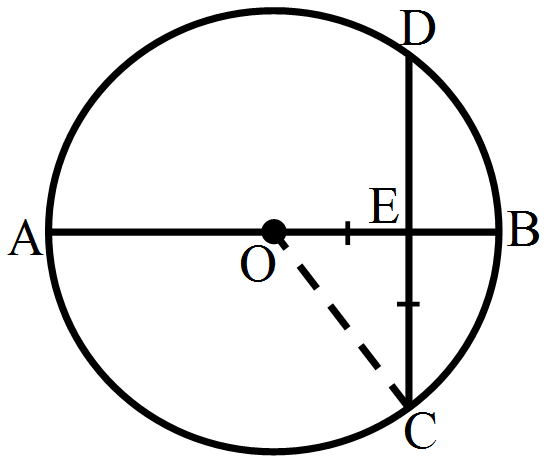
Given: $CE = ED = 8\ cm$ and $EB = 4cm$ Join $OC.$

 Let $OC = OB =$ $r\ cm$ [Radii of a circle]
Then $OE$ $= (r - 4)\ cm$ Now, in right angled $\triangle\text{OEC},$
we have: $OC^2 = OE^2 + EC^2$[Pythagoras theorem]
$\Rightarrow r^2 = (r - 4)^2 + 8^2$
$\Rightarrow r^2 = r^2 - 8r + 16 + 64$
$\Rightarrow r^2 = r^2 + 8r = 80$
$\Rightarrow 8r = 80$
$\Rightarrow\ \text{r}=\Big(\frac{80}{8}\Big)\text{cm}=10\text{cm}$
$\Rightarrow r = 10\ cm$
Hence, the required radius of the circle is $10\ cm$.

Need a full question paper?

Generate a complete, print-ready paper with questions like this in minutes — across 16+ boards, with answer keys.
Start Generating Free

Similar questions

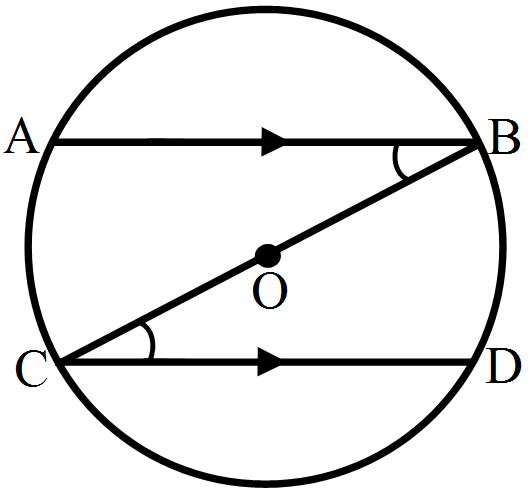
In the adjoining figure, $BC$ is a diameter of a circle with centre $O.$ If $AB$ and $CD$ are two chords such that $AB || CD,$ prove that $AB = CD.$
The polynomial $p(x)=x^4-2 x^3+3 x^2-a x+3 a-7$ when divided by $x+1$ leave remainder $19 .$ Find the remainder when $p(x)$ is divided by $x +2$.
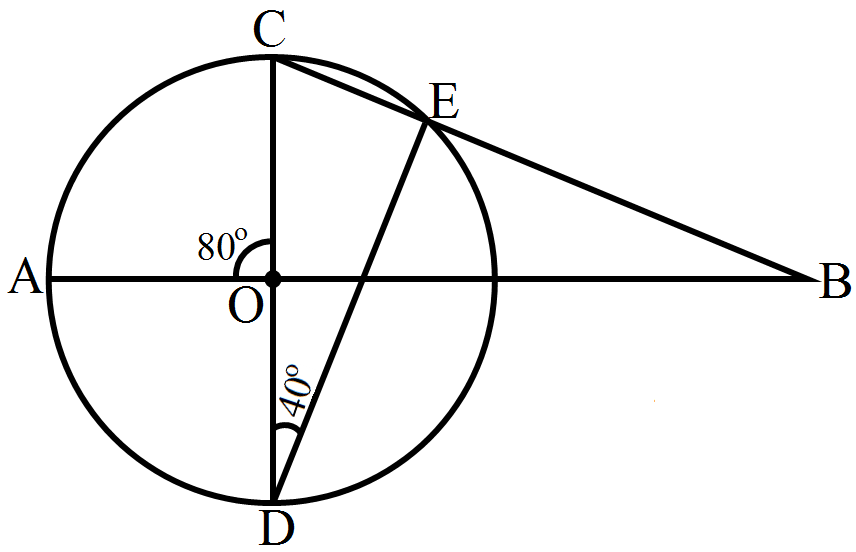
In the given figure, $AB$ and $CD$ are straight lines through the centre $O$ of a circle. If $\angle\text{AOC}=80^\circ$ and $\angle\text{CDE}=40^\circ,$ find
$i. \angle\text{DCE}$
$ii. \angle\text{ABC}$
Find the cost of sinking a tube well $280\ m$ deep, having diameter 3m at the rate of ₹ $3.60$ per cubic metre. Find also the cost of cementing its inner curved surface at ₹ $2.50$ per square metre.
Explain, by taking a suitable example, how the arithmetic mean alters by:
$i.$ Adding a constant $k$ to each term.
$ii.$ Subtracting a constant $k$ from each term.
$iii.$ Multiplying each term by a constant $k.$
$iv.$ Dividing each term by non-zero constant $k.$
The mean of $20$ numbers is $18$. If $3$ is added to each of the first ten numbers, find the mean of the new set of $20$ numbers.
The total surface area of a solid cylinder is $231cm^2$ and its curved surface area is $\frac{2}{3}$ of the total surface area. Find the volume of the cylinder.
The line segments joining the midpoints $M$ and $N$ of parallel sides $AB$ and $DC$ respectively of a trapezium $ABCD$ is perpendicular to both the sides $AB$ and $DC$. Prove that $AD = BC$.
Find the value of $p$, when the mean of the following distribution is $20$.
x
$15$
$17$
$19$
$20 + p$
$23$
f
$2$
$3$
$4$
$5p$
$6$
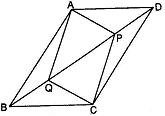
In parallelogram $A B C D$, two points $P$ and $Q$ are taken on diagonal $B D$ such that $D P=B Q$.

Show that
i. $\triangle APD \cong \triangle C Q B$
ii. $A P=C Q$
iii. $\triangle A Q B \cong \triangle C P D$
iv. $A Q=C P$
v. $APCQ$ is a parallelogram.