Question
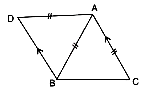
In the given figure, $A D=A B=A C, B D$ is parallel to $C A$ and angle $\text{ACB}$
$=65^{\circ}$. Find $\angle DAC.$
 

Answer

We can see that the $\triangle ABC$ is an isosceles triangle with Side $AB =$ Side $AC.$
$\Rightarrow \angle ACB = \angle ABC$
As $\angle ACB = 65^\circ $
hence $\angle ABC = 65^\circ $
Sum of all the angles of a triangle is $180^\circ $
$\angle ACB + \angle CAB + \angle ABC = 180^\circ $
$65^\circ + 65^\circ + \angle CAB = 180^\circ $
$\angle CAB = 180^\circ − 130^\circ $
$\angle CAB = 50^\circ $ As $BD$ is parallel to $CA$
Therefore, $\angle CAB = \angle DBA$ since they are alternate angles.
$\angle CAB = \angle DBA = 50^\circ $
We see that $\triangle ADB$ is an isosceles triangle with Side $AD =$ Side $AB.$
$\Rightarrow \angle ADB = \angle DBA = 50^\circ $
Sum of all the angles of a triangle is $180^\circ $
$\angle ADB + \angle DAB + \angle DBA = 180^\circ $
$50^\circ + \angle DAB + 50^\circ = 180^\circ $
$\angle DAB = 180^\circ − 100^\circ = 80^\circ $
$\angle DAB = 80^\circ $
The $\angle DAC$ is the sum of $\angle DAB$ and $\text{CAB}.$
$\angle DAC = \angle CAB + \angle DAB$
$\angle DAC = 50^\circ + 80^\circ $
$\angle DAC = 130^\circ $

Need a full question paper?

Generate a complete, print-ready paper with questions like this in minutes — across 16+ boards, with answer keys.
Start Generating Free