Answer

  1. 1 : 1
    Solution:
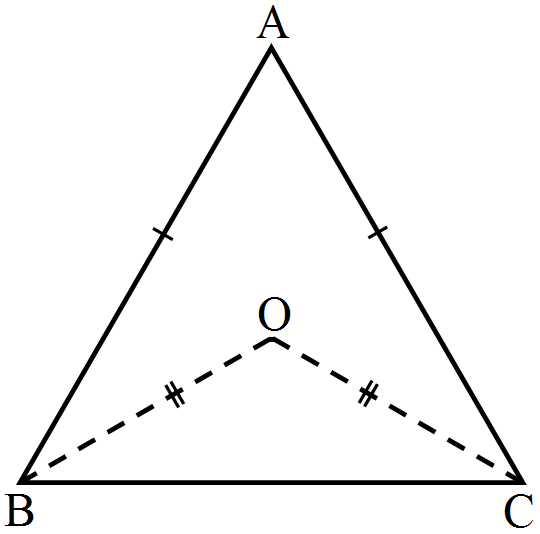
    In $\triangle\text{ABC},$
    $\text{AB = AC}\Rightarrow\angle\text{ABC}=\angle\text{ACB}...(\text{i})$
    In $\triangle\text{OBC},$
    $\text{OB = OC} \Rightarrow\angle\text{OBC}=\angle\text{OCB}...(\text{ii})$
    Subtraction (ii) from (i), we get
    $\Rightarrow\angle\text{ABO}=\angle\text{ACO}$
    So, $\angle\text{ABO}:\angle\text{ACO}=1:1$

Need a full question paper?

Generate a complete, print-ready paper with questions like this in minutes — across 16+ boards, with answer keys.
Start Generating Free

Similar questions

The number of triangles that can be drawn having angles as 50º, 60º and 70º are:
The weight of $10$ students $($in$ \ kg)$ are: $ 55, 40, 35, 60, 38, 36, 45, 31, 44.$
The median weight is:
D and E are the mid-points of the sides AB and AC res. Of $\triangle\text{ABC}.$ DE is produced to F. To prove that CF is equal and parallel to DA, we need an additional information which is:
Let $\bar{\text{x}}$ be thae mean of $x_1, x_2, ......, x_n,$ and $\bar{\text{y}}$ the mean of $y_1 , y_2 , ... , y_n$ . If $\bar{\text{z}}$ is the mean of $x_1 , x_2 , ... , x_n , y_1 , y_2, ... , yn,$ then $\bar{\text{z}}$ is equal to:
The sides of a triangular flower bed are 5m, 8m and 11m. the area of the flower bed is:
When $p(x) = x^3 + ax^2 + 2x +a$ is divided by $(x + a),$ the remainder is:
In a histogram the class intervals or the group are taken along:
  1. Y-axis.
  2. X-axis.
  3. Both of X-axis and Y-axis.
  4. In between X and Y axis.
ABCD is a parallelogram, M is the mid-point of BD and BM bisects $\angle\text{B}.$ Then, $\angle\text{AMB}=$
Is || gm ABCD a square?
  1. Diagonals of || gm ABCD are equal.
  2. Diagonals of || gm ABCD intersect at right angles.
  1. If the question can be answered by one of the given statements alone and not by the other;
  2. If the question can be answered by either statement alone;
  3. If the question can be answered by both the statements together but not by any one of the two;
  4. If the question cannot be answered by using both the statements together.
The area of the curved surface of a cone of radius 2r and slant height $\frac{\text{l}}{2},$ is: