Question
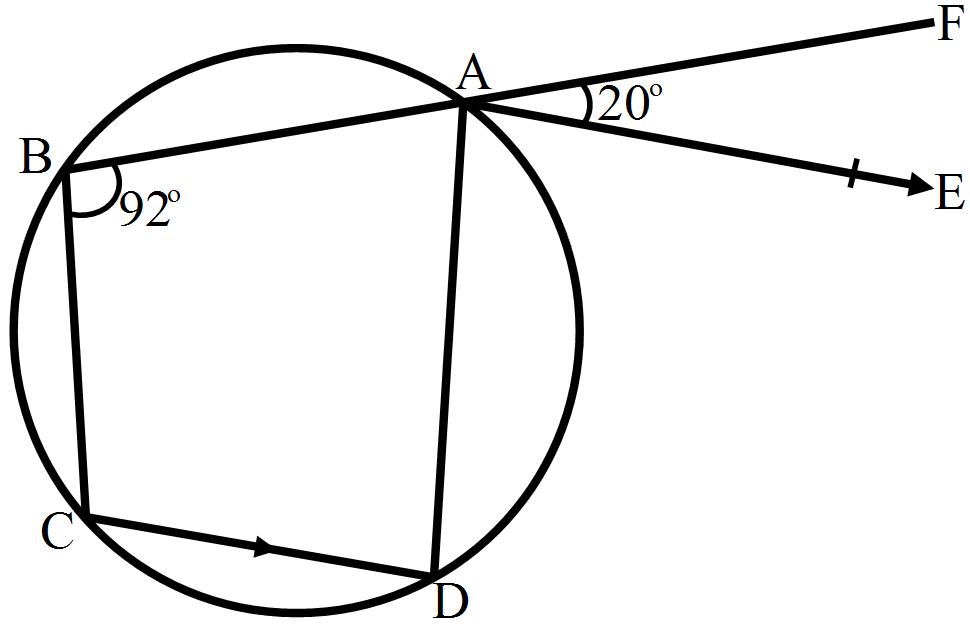
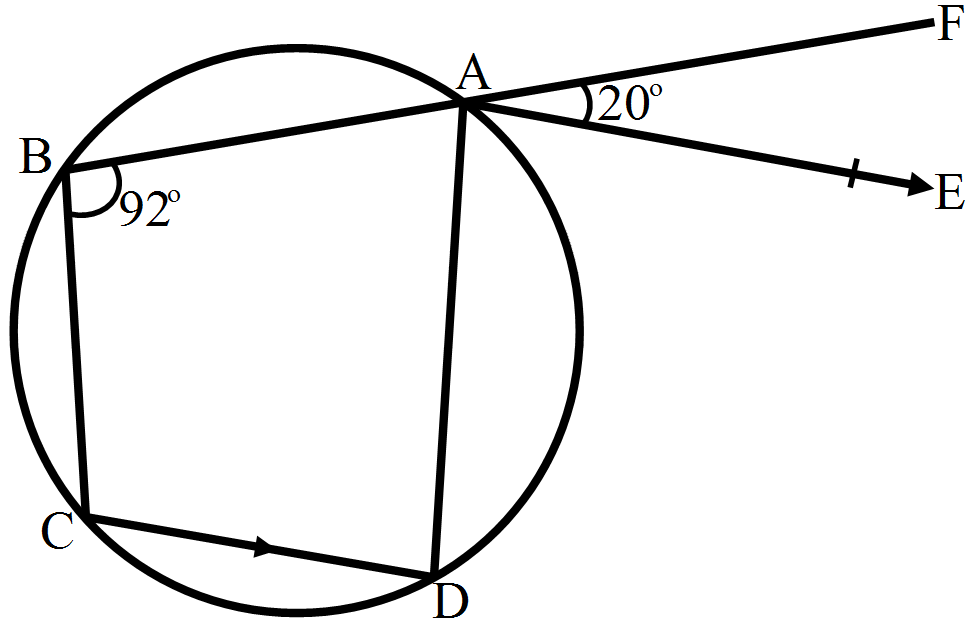
In the given figure, ABCD is a cyclic quadrilateral in which AE is drawn parallel to CD, and BA is produced. If $\angle\text{ABC}=92^\circ$ and $\angle\text{FAE}=20^\circ,$ find $\angle\text{BCD}.$
Answer


Given: ABCD is a cyclic quadrilateral.
Then $\angle\text{ABC}+\angle\text{ADC}=180^\circ$
$\Rightarrow\ 92^\circ+\angle\text{ADC}=180^\circ$
$\Rightarrow\ \angle\text{ADC}=(180^\circ-92^\circ)=88^\circ$
Again, AE parallel to CD.
Thus, $\angle\text{EAD}=\angle\text{ADC}=88^\circ$ [Alternate angles]
We know that the exterior angle of a cyclic quadrilateral is equal to the interior opposite angle.
$\therefore\ \angle\text{BCD}=\angle\text{DAF}$
$\Rightarrow\ \angle\text{BCD}=\angle\text{EAD}+\angle\text{EAF}$
$=88^\circ+20^\circ=108^\circ$
Hence, $\angle\text{BCD}=108^\circ$

Need a full question paper?

Generate a complete, print-ready paper with questions like this in minutes — across 16+ boards, with answer keys.
Start Generating Free

Similar questions

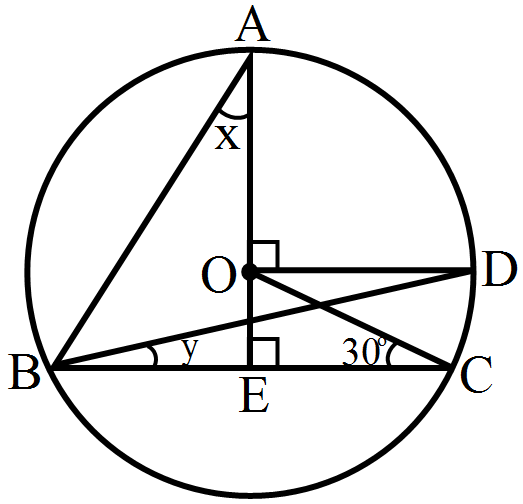
In the given figure, O is the centre of the circle and $\angle\text{BCO}=30^\circ.$ Find x and y.

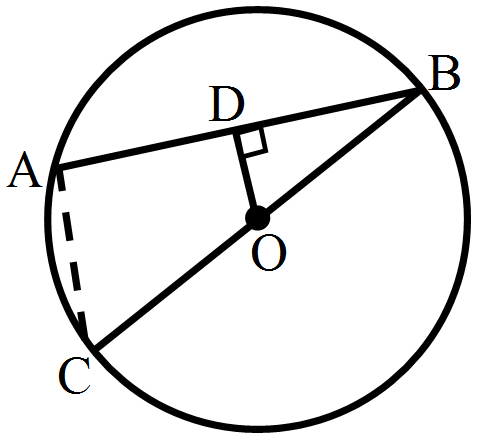
In the adjoining figure, OD is perpendicular to the chord AB of a circle with centre O. If BC is a diameter, show that AC || CD and AC = 2 × OD.

In a $\triangle\text{ABC},\angle\text{ABC}=\angle\text{ACB}$ and the bisectors of $\angle\text{ABC}$ and $\angle\text{ACB}$ intersect at O such that $\angle\text{BOC}=120^\circ.$ Show that $\angle\text{A}=\angle\text{B}=\angle\text{C}=60^\circ.$
The sum of the deviations of a set of n values x1, x2, x3,..., xn measured from 15 and -3 are -90 and 54 respectively. Find the value of n and mean.
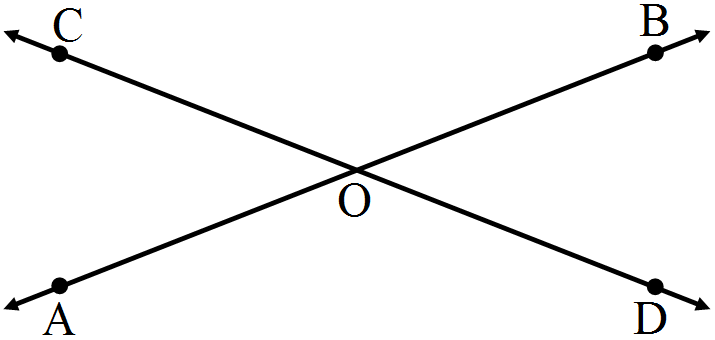
Two lines AB and CD intersect at a point O, such that $\angle\text{BOC}+\angle\text{AOD}=280^\circ,$ as shown in the figure. Find all the four angles.

The factors of x4 + x2 + 25 are:
  1. (x2 + 3x + 5)(x2 - 3x + 5)
  2. (x2 + 3x + 5)(x2 + 3x − 5)
  3. (x2 + x +5)(x2 - x + 5)
  4. None of these.
The difference between the semiperimeter and the sides of a $\triangle\text{ABC}$ are 8cm, 7cm and 5cm respectively. Find the area of the triangle.
The line segments joining the midpoints M and N of parallel sides AB and DC respectively of a trapezium ABCD is perpendicular to both the sides AB and DC. Prove that AD = BC.
The polynomial p(x) = x4 - 2x3 + 3x2 - ax + b when divided by (x - 1) and (x + 1) leaves the remainders 5 and 19 respectively. Find the values of a and b. Hence, find the remainder when p(x) is divided by (x - 2).
If O is a point within $\triangle\text{ABC,}$ show that:
  1. AB + AC > OB + OC
  2. AB + BC + CA > OA + OB + OC
  3. OA + OB + OC > $\frac{1}{2}$ (AB + BC + CA).