Question
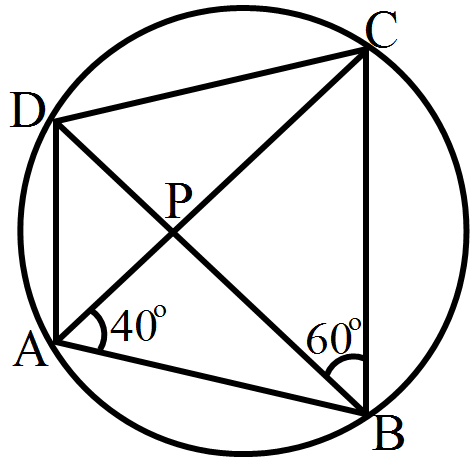
In the given figure, ABCD is a cyclic quadrilateral whose diagonals intersect at P such that $\angle\text{DBC}=60^\circ$and $\angle\text{BAC}=40^\circ.$ Find 
  1. $\angle\text{BCD}$
  2. $\angle\text{CAD}$

Answer

  1. $\angle\text{BDC}=\angle\text{BAC}=40^\circ$ [Angles in the same segment]
In $\triangle\text{BCD},$ we have:
$\angle\text{BCD}+\angle\text{DBC}+\angle\text{BDC}=180^\circ$ [Angle sum property of a triangle]
$\Rightarrow\ \angle\text{BCD}+60^\circ+40^\circ=180^\circ$
$\Rightarrow\ \angle\text{BCD}=(180^\circ-100^\circ)=80^\circ$
  1. $\angle\text{CAD}=\angle\text{CBD}$ [Angles in the same segment]
$=60^\circ$

Need a full question paper?

Generate a complete, print-ready paper with questions like this in minutes — across 16+ boards, with answer keys.

Start Generating Free

Similar questions

Factorise:
$\text{x}^2+\frac{1}{\text{x}^2}-3$
If $3^\text{x}=5^\text{y}=(75^\text{z}),$ show that $\text{z}=\frac{\text{xy}}{2\text{x}+\text{y}}.$
Two chords AB and AC of a circle subtends angles equal to 90° and 150°, respectively at the centre. Find $\angle\text{BAC},$ if AB and AC lie on the opposite sides of the centre.
Factorize : $a^2x^2 + (ax^2 + 1)x + a$
Verify whether the indicated numbers are zeros of the polynomials corresponding to them in the following case:
$\text{f(x)}=5\text{x}-\pi,\text{x}=\frac{4}{5}$
Evaluate:
$\Big(\frac{64}{125}\Big)^{-\frac{2}{3}}+\Big(\frac{256}{625}\Big)^{-\frac{1}{4}}+\Big(\frac{3}{7}\Big)^0$
A cube of $9\ cm$ edge is immersed completely in a rectangular vessel containing water. If the dimensions of the base are $15\ cm$ and $12\ cm,$ find the rise in water level in the vessel.
Factorise $: x^{8 }- 1$
A company selected 4000 households at random and surveyed them to find out a relationship between income level and the number of television sets in a home. The information so obtained is listed in the following table:
Monthly income (in Rs.) Number of Televisions/ household
  0 1 2 Above 2
<10000
10000-14999
15000-19999
20000-24999
25000 and above
20
10
0
0
0
80
240
380
520
1100
10
60
120
370
760
0
0
30
80
220
Find the probability:
  1. Of a household earning Rs. 10000 - Rs 14999 per year and having exactly one television.
  2. Of a household earning Rs. 25000 and more per year and owning 2 televisions.
  3. Of a household not having any television.
Metal spheres, each of radius $2\ cm$, are packed into a rectangular box of internal dimensions $16\ cm \times 8\ cm \times 8\ cm.$ When $16$ spheres are packed the box is filled with preservative liquid. Find the volume of this liquid. Give your answer to the nearest integer. $[\text{Use }\pi=3.14]$