Question
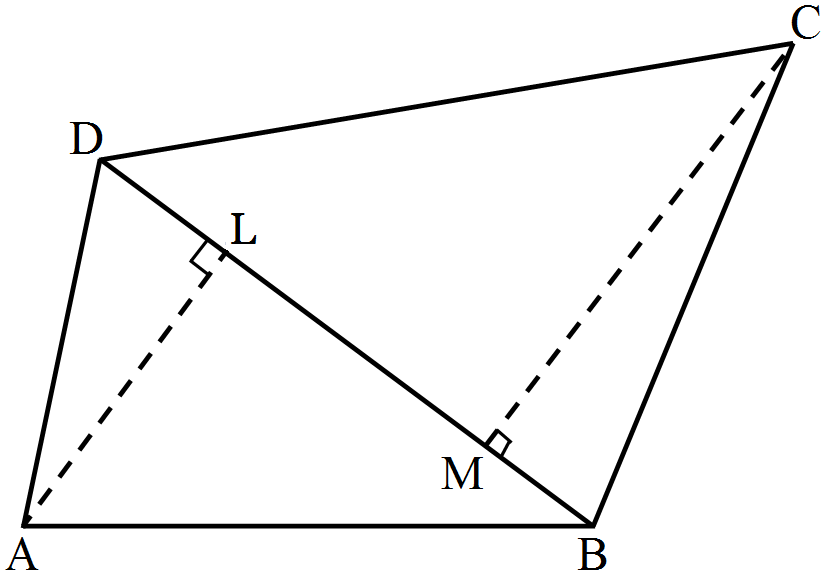
In the given figure, $ABCD$ is a quadrilateral in which diagonal $BD = 24\ cm,\text{AL}\perp\text{BD}$ and $\text{CM}\perp\text{BD}$ such that $AL = 9\ cm$ and $CM = 12\ cm.$ Calculate the area of the quadrilateral.
Answer

Given,
$BD = 24\ cm$
$AL = 9\ cm$
$CM = 12\ cm$
Area of $\triangle\text{BCD}=\frac{1}{2}\times\text{BD}\times\text{CD}$
$=\frac12\times24\times12=144\text{cm}^2$
Area of $\triangle\text{DAB}=\frac{1}{2}\times\text{BD}\times\text{AL}$
$=\frac12\times24\times9=108\text{cm}^2$
Now, area of quadrilateral $ABCD =$ Area of $\triangle\text{BCD}$ $+$ Area of $\triangle\text{DAB}$
$=(144+108) \mathrm{cm}^2 $
$=252 \mathrm{~cm}^2$

Need a full question paper?

Generate a complete, print-ready paper with questions like this in minutes — across 16+ boards, with answer keys.
Start Generating Free

Similar questions

An express train takes $1$ hour less than a passenger train to travel $132\ km$ between Mysore and Banglore. If the average speed of the express train is $11\ km/ hr$ more than that of the passenger train, from the quadratic equation to find the average speed of express train.
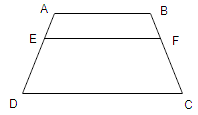
$ABCD$ is a trapezium with $AB || DC. E$ and $F$ are two points on non-parallel sides $AD$ and $BC$ respectively, such that $EF$ is parallel to $AB.$ Show that $\frac{AE}{ED}=\frac{BF}{FC}$ 
Water in a canal $1.5m$ wide and 6m deep is flowing with a speed of $10\ km/hr$. How much area will it irrigate in $30$ minutes if $8\ cm$ of standing water is desired$?$
Ayush starts walking from his house to office. Instead of going to the office directly, he goes to a bank first, from there to his daughter’s school and then reaches the office. What is the extra distance travelled by Ayush in reaching the office$? ($Assume that all distance covered are in straight lines$).$ If the house is situated at $(2, 4),$ bank at $(5, 8),$ school at $(13, 14)$ and office at $(13, 26)$ and coordinates are in kilometers.
Show that the following numbers are irrational.
$7\sqrt{5}$
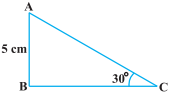
In $\triangle A B C$, right-angled at $B, A B=5 cm$ and $\angle A C B=30^{\circ}$. Determine the lengths os sides $B C$ and $A C$.
Express the following as a fraction in simplest form:
$2.\bar4$
Name the quadrilateral formed, if any, by the following points, and given reason for your answers:
$A(-1, -2), B(1, 0), C(-1, 2), D(-3, 0).$
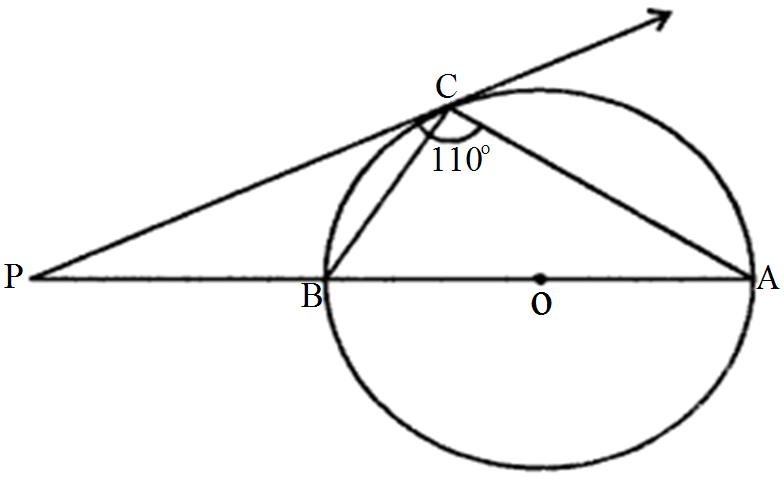
In the figure, the tangent at a point $C$ of a circle and a diameter $AB$ when extended itersect at $P.$ If $\angle\text{PCA}=110^{\circ},$ find $\angle\text{CBA}.$
A bag contains cards which are numbered form $2$ to $90$. A card is drawn at random from the bag. Find the probability that it bears:
  1. A two digit number.
  2. A number which is a perfect square.