Question
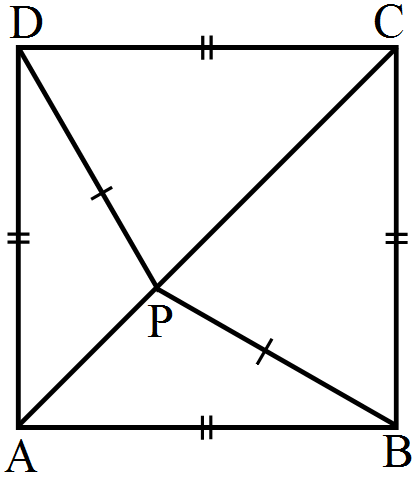
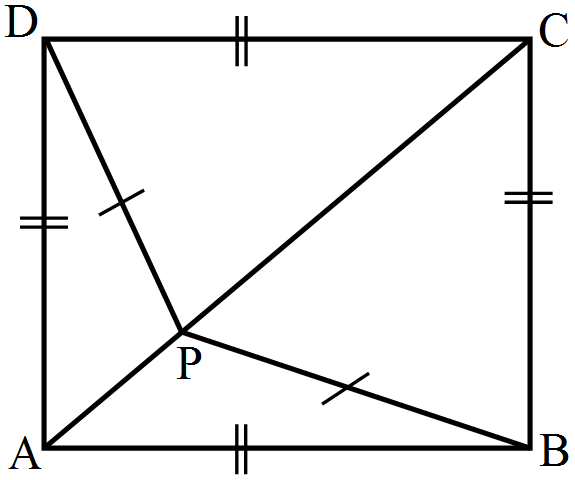
In the given figure, $ABCD$ is a square and $P$ is a point inside it such that $PB = PD$. Prove that $CPA$ is a straight line.
Answer

Given: $ABCD$ is a sqaure and $P$ is a point inside it such that $PB = PD$.

To Prove: $CPA$ is a straight line.
Proof: In $\triangle\text{APD}$ and $\triangle\text{APB}$
$\text{DA = AB}$ [$\therefore$ $ABCD$ is a square]
$\text{AP = AP}$ [Common]
and, $\text{PB = PD}$ [Given]
Thus by Side-Side-Side criterion of congruence, we have
$\triangle\text{APD}\cong\triangle\text{APB}$
The corresponding parts of the congruent triangles are equal.
$\therefore\angle\text{APD}=\angle\text{APB}...(1)$
Now consider the triangles, $\triangle\text{CPD}$ and $\triangle\text{CPB}.$
$\text{CD = CB}$ [$\therefore$ $ABCD$ is a square]
$\text{CP = CP}$ [Common]
and, $\text{PB = PD}$ [Given]
Thus by Side-Side-Side criterion of congruence, we have
$\triangle\text{CPD}\cong\triangle\text{CPB}$
The corresponding parts of the congruents triangle are equal.
Hence we have
$\angle\text{CPD}=\angle\text{CPB}....(2)$
Adding both sides of $(1)$ and $(2)$ we get
$\angle\text{APD}+\angle\text{CPD}=\angle\text{APB}+\angle\text{CPB}...(3)$
Angles aronud the point $P$ add upto $360^\circ$,
$\Rightarrow\angle\text{APD}+\angle\text{CPD}+\angle\text{APB}+\angle\text{CPB}=360^{\circ}$
$\Rightarrow\angle\text{APB}+\angle\text{CPB}=360^{\circ}-(\angle\text{APD}+\angle\text{CPD})...(4)$
Substituting $(4)$ in $(3)$ we get,
$\angle\text{APD}+\angle\text{CPD}=360^{\circ}-(\angle\text{APD}+\angle\text{CPD})$
i.e. $2(\angle\text{APD}+\angle\text{CPD})=360^{\circ}$
$\angle\text{APD}+\angle\text{CPD}=\frac{360}{2}=180^{\circ}$
This proves that $CPA$ is a straight line.

Need a full question paper?

Generate a complete, print-ready paper with questions like this in minutes — across 16+ boards, with answer keys.

Start Generating Free

Similar questions

The line segments joining the midpoints $M$ and $N$ of parallel sides $AB$ and $DC$ respectively of a trapezium $ABCD$ is perpendicular to both the sides $AB$ and $DC$. Prove that $AD = BC$.
The lengths of 62 leaves of a plant are measured in millimetres and the data is represented in the following table:
Length (in mm)Number of leaves
118-1268
127-13510
136-14412
144-15317
154-1627
163-1715
172-1803
Number of leaves
Find the values of $a$ and $b$ if $\frac{7+3 \sqrt{5}}{3+\sqrt{5}}-\frac{7-3 \sqrt{5}}{3-\sqrt{5}}=a+b \sqrt{5}$.
If $\left(x^3+a x^2+b x+6\right)$ has $(x-2)$ as a factor and leaves a remainder $3$ when divided by $(x-3)$, find the values of $a$ and $b$.
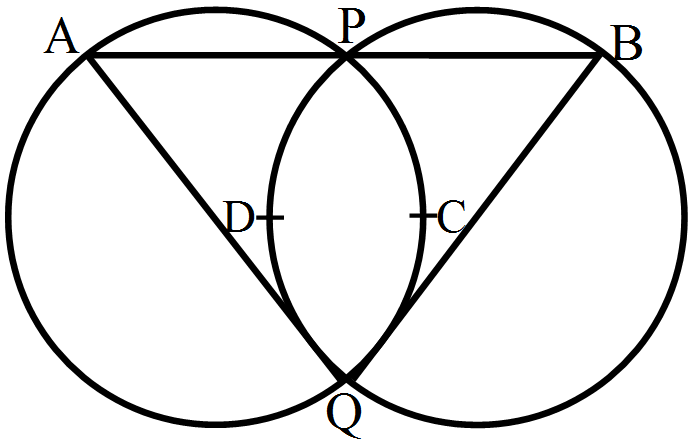
Two equal circles intersect in $P$ and $Q$. A straight line through $P$ meets the circles in $A$ and $B$. Prove that $QA = QB$.
Show that the quadrilateral formed by joining the midpoints of the pairs of adjacent sides of a square is a square.
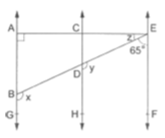
In the given figure, $AB \| CD \| EF , \angle D B G=x, \angle E D H=y, \angle A E B=z, \angle E A B=90^{\circ}$ and $\angle B E F=65^{\circ}$. Find the values of $x , y$ and $z$ .
Image
The numbers $50, 42, 35, (2x + 10), (2x - 8), 12, 11, 8$ have been written in a descending order. If their median is $25$, find the value of $x$.
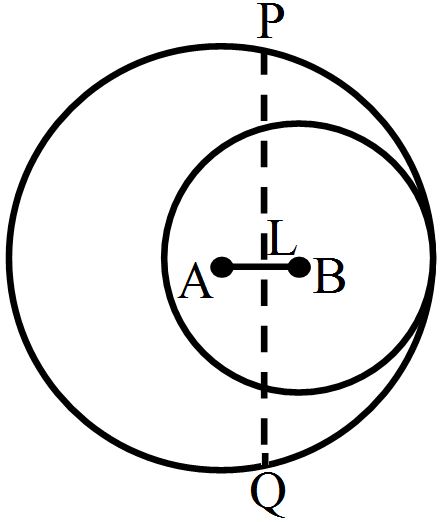
In the adjoining figure, two circles with centres at $A$ and $B$ , and of radii $5\  cm$ and $3\ cm$ touch each other internally. If the perpendicular bisector of $A B$ meets the bigger circle in $P$ and $Q$, find the length of $P Q$.
The factors of $8a^3 + b^3 - 6ab + 1$ are: