MCQ
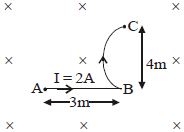
In the given figure force on wire $ABC$ will be $(B = 2T)$
  • A
    $4(3+2\pi ) N$
  • $20\,N$
  • C
    $10\,N$
  • D
    $40\,N$

Answer

Correct option: B.
$20\,N$
b
Force an $\mathrm{AB}=\mathrm{BI} \ell=12 \mathrm{\,N}$ (upward)

Force on $\mathrm{BC}=16 \mathrm{\,N}$ (left)

so force on $\mathrm{ABC}=\sqrt{(12)^{2}+(16)^{2}}=20 \mathrm{\,N}$

Need a full question paper?

Generate a complete, print-ready paper with questions like this in minutes — across 16+ boards, with answer keys.

Start Generating Free

Similar questions

A narrow parallel beam of light falls on a glass sphere of radius $R$ and refractive index $\mu$ at normal incidence. The distance of the image from the outer edge is given by
The absorption of radio waves by the atmosphere depends upon:
Nuclear reactions are given as $(i)$ ${(n,\;p)_{15}}{p^{32}}$ $(ii)$ ${(p,\;\alpha )_8}{O^{16}}$ $(iii)$ $_7{N^{14}}$ $( p)$ $_6{C^{14}}$ missing particle or nuclide (in $box$ ) in these reactions are respectively
Two coils of self inductances $2\, mH$ and $8\, mH$ Hare placed so close together that the effective flux in one coil is completely linked with the other. The mutual inductance between these coils is......$mH$
The centre of a wheel rolling on a plane surface moves with a speed $v_0$. A particle on the rim of the wheel at the same level as the centre will be moving at speed:
$CO_2$ gas is found in which of the following pairs of the planet
When the current $i$ is flowing through a conductor, the drift velocity is $v$. If $2i$ current is flowed through the same metal but having double the area of cross-section, then the drift velocity will be
If half life of an element is $69.3$ hours then how much of its percent will decay in $10^{\text {th }}$ to $11^{\text {th }}$ hours. Initial activity $=50\, \mu Ci$
Your are given three equal resistances. In how many combinations can they be arranged?
"The work per unit of charge required to move a charge from a reference point to a specified point, measured in joules per coulomb or volts. The static electric field is the negative of the gradient of the electric potential." comments are given below, select the correct one: