Question
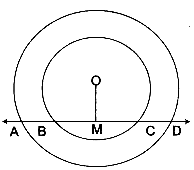
In the given figure, l is a line intersecting the two concentric circles, whose common center is O, at the points A, B, C, and D. Show that AB = CD.
Answer

Let OM be perpendicular from O on line l.
We know that the perpendicular from the centre of a circle to as chord; bisect the chord.
Since BC is a chord of the smaller circle and OM ⊥ BC.
∴ BM = CM....(i)
Again, AD is a chord of the larger circle and OM ⊥ AD.
∴ AM = DM....(ii)
Subtracting (i) from (ii), we get,
AM - BM = DM - CM ⇒ AB = CD
Hence proved.

Need a full question paper?

Generate a complete, print-ready paper with questions like this in minutes — across 16+ boards, with answer keys.

Start Generating Free

Similar questions

Given the following details, calculate the simple interest at the rate of 6% per annum up to June, 30:
Date Debit (in ₹) Credit (in ₹) Balance (in ₹)
January 1 - 24,000·00 24,000·00
January 20 5,000·00 - 19,000·00
January 29 - 10,000·00 29,000·00
March 15 - 8,000·00 37,000·00
April 3 - 7,653·00 44,653·00
May 6 3,040·00 - 41,613·00
May 8 - 5,087·00 46,700·00
A solid metal sphere is cut through its center into $2$ equal parts. If the diameter of the sphere is $3 \frac{1}{2} \ cm,$ find the total surface area of each part correct to two decimal places.
A bag contains 3 white, 5 black and 2 red balls, all of the same shape and size. A ball is drawn from the bag without looking into it, find the probability that the ball drawn White ball.
In each of the following, determine whether the given numbers are solutions of the given equation or not: $x^2-3 \sqrt{3} x+6=0 ; \sqrt{3},-2 \sqrt{3}$
If $(x - 9) : (3x + 6)$ is the duplicate ratio of $4 : 9,$ find the value of x.
Solve the inequation 3x -11 < 3 where x ∈ {1, 2, 3,……, 10}. Also represent its solution on a number line
Prove that $\sec^2 (90^\circ - \theta ) + \tan^2 (90^\circ - \theta ) = 1 + 2 \cot^2 \theta .$
A bag contains a red ball , a blue ball and a yellow ball , all the balls being of the same size . Anjali takes out a ball from the bag without looking into it . what is the probability that she takes out .
(ii) red ball?
A glass cylinder with a diameter $20 \ cm$ has water to a height of $9 \ cm$. A metal cube of 8 cm edge is immersed in it completely. Calculate the height by which the water will up in the cylinder. Answer correct of the nearest mm. (Take $\pi = 3.142)$
Triangles ABC and DEF are similar.
If area $(\triangle ABC) = 36 cm^2$​​​​​​​, area $(\triangle DEF) = 64 cm^2$​​​​​​​​​​​​​​ and $DE = 6.2\ cm$, find $AB$.