Question
In the given figure, show that: $\angle a =\angle b +\angle c$
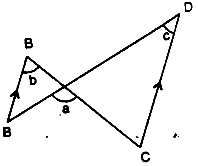
(i) If $\angle b =60^{\circ}$ and $\angle c =50^{\circ}$; find $\angle a$.
(ii) If $\angle a =100^{\circ}$ and $\angle b =55^{\circ}$ : find $\angle c$.
(iii) If $\angle a =108^{\circ}$ and $\angle c =48^{\circ}$; find $\angle b$.
Answer

∵ AB || CD
∴ b = c and ∠A = ∠C ........(Alternate angles)
Now in Δ PCD,
Ext. ∠APC = ∠C + ∠D
⇒ a = b + c
(i) If b = 60°, c = 50°, then
a = b + c = 60° + 50° = 110°
(ii) If a = 100° and b = 55°,
then a = b + c
⇒ 100° = 55°+ c
⇒ c = 100°− 55° = 45°
(iii) If a = 108° and c = 48°
then a = b + c
⇒ 108° = b + 48°
⇒ b = 108°− 48° = 60°

Need a full question paper?

Generate a complete, print-ready paper with questions like this in minutes — across 16+ boards, with answer keys.

Start Generating Free

Similar questions

The marks obtained by a student in his annual examination in various subjects are given below :
Subject Hindi Mathematics English Science S.Studies
Marks obtained 6440528036
Represent the above data by a bar graph.
Simplify: $2 \frac{3}{4}-\left[3 \frac{1}{8} \div\left\{5-\left(4 \frac{2}{3}-\frac{11}{12}\right)\right\}\right]$
Radhika is in the Chemistry Laboratory and is working on a practical. She mixed three salts A, B and C taking 150 gm of A and 300 gm each of B and C to prepare a mixture X.
Q.1. The percentage of salt A in mixture X is:
(a) 15% $\quad$$\quad$(b) 20% $\quad$$\quad$(c) 25%$\quad$$\quad$ (d) 30%
Q.2. By what percent is salt C more than salt A in mixture X?
(a) 50% $\quad$$\quad$(b) 100%$\quad$$\quad$ (c) 150% $\quad$$\quad$(d) 200%
Q.3. Radhika added 250 gm of salt B to mixture X to prepare a new mixture Y. By what per cent did salt B increase
(a) $63 \frac{1}{3} \%$$\quad$$\quad$ (b) $75 \%$ $\quad$$\quad$(c) $83 \frac{1}{3} \%$ $\quad$$\quad$(d) $121 \%$
Q.4. The percentage of salt A in mixture Y is :
(a) $15 \%$ $\quad$$\quad$(b) $17 \frac{1}{2} \%$ $\quad$$\quad$(c) $20 \%$$\quad$$\quad$ (d) $22 \frac{1}{2} \%$
In the given figure, the directed lines are parallel to each other. Find the unknown angles.

A and B working together can do a piece of work in 10 days B alone can do the same work in 15 days. How long will A alone take to do the same work?
Evaluate: $\frac{-9}{4}+\frac{13}{3}+\frac{25}{6}$
A sum amounts to Rs. 2,652 in 6 years at 5% p.a. simple interest. Find:
(i) the sum
(ii) the time in which the same sum will double itself at the same rate of interest.
Two coins are tossed simultaneously 100 times and the outcomes are as given below:
Outcomes Two heads
(H, H)
Exactly one head
(H T or T H)
No head
(T T)
No. of times 21 55 24
If the same pair of coins is tossed again at random, find the probability of getting:
(i) two heads
(ii) exactly one head
(iii) no head.
Arrange the given rational numbers in descending order:
$\frac{3}{-10}, \frac{-13}{30} \text { and } \frac{8}{-20}$