Question
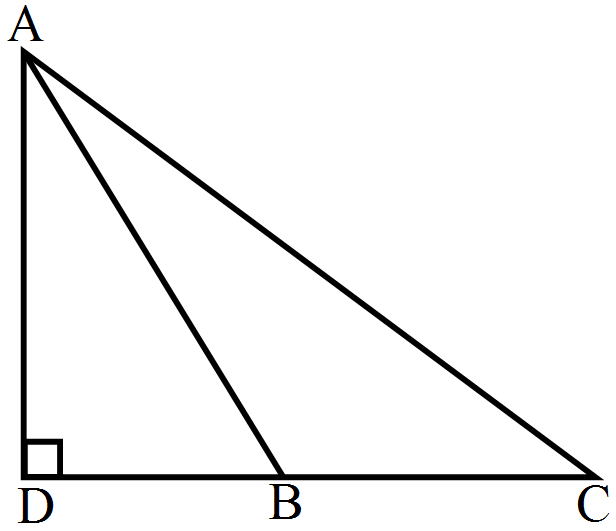
In the given figure, $\triangle\text{ABC}$ is an obtuse triangle, obtuse-angled at B. If $\text{AD}\perp\text{CB}$ (produced) prove that $AC^2= AB^2+ BC^2+2BC.BD.$
Answer


Applying Pythagoras theorem in right-angled triangle $ADC$, we get:
$A C^2=A D^2+D C^2 $
$ \Rightarrow A C^2-D C^2=A D^2 $
$ \Rightarrow A D^2=A C^2-D C^2...(1)$
Applying Oythagoras theorem in right-triangle $ADB$, we get:
$ A B^2=A D^2+D B^2 $
$ \Rightarrow A B^2-D B^2=A D^2 $
$ \Rightarrow A D^2=A B^2-D B^2...(2)$
From equation $(1)$ and $(2)$,, we have:
$A C^2-D C^2=A B^2-D B^2 $
$ \Rightarrow A C^2=A B^2+D C^2-D B^2 $
$ \Rightarrow A C^2=A B^2+(D B+B C)^2-D B^2(\therefore D B+B C=D C) $
$ \Rightarrow A C^2=A B^2+D B^2+B C^2+2 D B \cdot B C-D B^2 $
$ \Rightarrow A C^2=A B^2+B C^2+2 B C \cdot B D$
This completes the proof.

Need a full question paper?

Generate a complete, print-ready paper with questions like this in minutes — across 16+ boards, with answer keys.

Start Generating Free

Similar questions

State the converse of Thales' theorem.
The following frequency distribution gives the monthly consumption of electricity of $68$ consumers of a locality. Find the median, mean and mode of the data and compare them.
Monthly consumption (in units) Number of Consumers
$65-85$ $4$
$85-105$ $5$
$105-125$ $13$
$125-145$ $20$
$145-165$ $14$
$165-185$ $8$
$185-205$ $4$
The sum of two numbers is $16$. The sum of their reciprocals is $\frac{1}{3}.$ Find the numbers.
A box contains cards numbered $3, 5, 7, 9, ..., 35, 37$. A card is drawn at random from the box. Find the probability that the number on the card is a prime number.
The given distribution shows the number of wickets taken by the bowlers in one-day international cricket matches:
Number of wickets
Less than $15$
Less than $30$
Less than $45$
Less than $60$
Less than $75$
Less than $90$
Less than $105$
Less than $120$
Number of bowlers
$2$
$5$
$9$
$17$
$39$
$54$
$70$
$80$
Draw a 'less than type' ogive from the above data. Find the median.
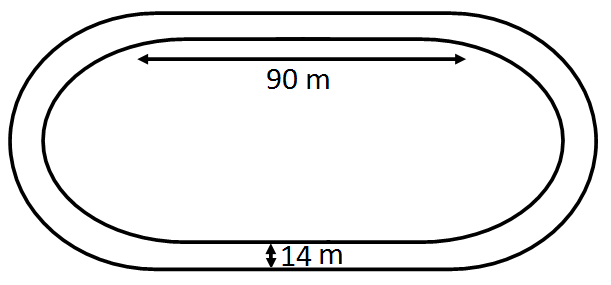
The inside perimeter of a running track (shown in the following figure) is $400\ m$. The length of each of the straight portion is $90\ m$ and the ends are semi-circles. If the track is everywhere $14\ m$ wide. find the area of the track. Also find the length of the outer running track.
Show that every positive odd integer is of the form $(4 q+1)$ or $(4 q+3)$ for some integer $q$.
Solve the following systems of equations by using the method of cross multiplication:
$6x - 5y - 16 = 0,$
$7x - 13y + 10 = 0$
In the following, one of the six trigonometric ratios is given. Find the values of the other trigonometric ratios.
$\sec\theta=\frac{13}{5}$
The sum of the squares of two consecutive multiples of $7$ is $1225$. Find the multiples.