Question
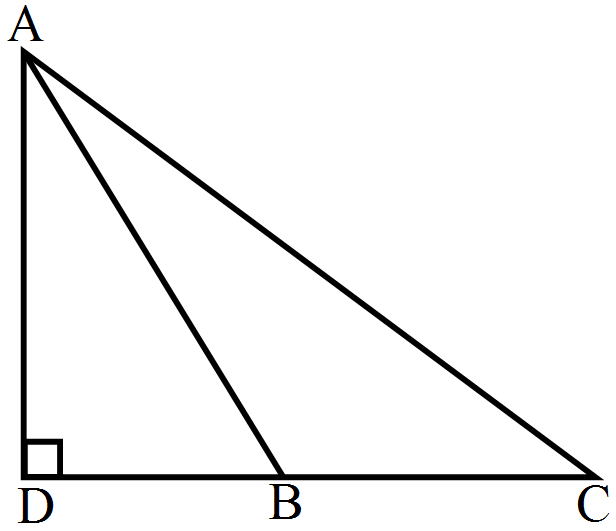
In the given figure, $\triangle\text{ABC}$ is an obtuse triangle, obtuse-angled at $B$. If $\text{AD}\perp\text{CB}$ (produced) prove that $AC^2 = AB^2+ BC^2 +2BC.BD.$
​​​​​​​

Answer


Applying Pythagoras theorem in right-angled triangle $ADC$, we get:
$AC^2= AD^2 + DC^2$
$\Rightarrow AC^2 - DC^2 = AD^2$
$\Rightarrow AD^2 = AC^2- DC^2 .....(1)$
Applying Oythagoras theorem in right-triangle $ADB,$ we get:
$AB^2 = AD^2 + DB^2$
$\Rightarrow AB^2 - DB^2= AD^2$
$\Rightarrow AD^2 = AB^2 - DB^2 .....(2)$
From equation $(1)$ and $(2)$, we have:
$AC^2 - DC^2 = AB^2 - DB^2$
$\Rightarrow AC^2 = AB^2 + DC^2 - DB^2$
$\Rightarrow AC^2 = AB^2 + (DB + BC)^2- DB^2$ $(\therefore\text{DB}+\text{BC}=\text{DC})$
$\Rightarrow AC^2 = AB^2 + DB^2 + BC^2 + 2DB.BC - DB^2$
$\Rightarrow AC^2 = AB^2 + BC^2 + 2BC.BD$
This completes the proof.

Need a full question paper?

Generate a complete, print-ready paper with questions like this in minutes — across 16+ boards, with answer keys.

Start Generating Free

Similar questions

A well with inner radius $4m$ is dug $14m$ deep. Earth taken out of it has been spread evenly all around a width of $3m$ it to form an embankment. Find the height of the embankment.
The length of the hypotenuse of a right-angled triangle exceeds the length of the base by 2cm and exceeds twice the length of the altitude by 1cm. Find the length of each side of the triangle.
Draw a histogram for the following frequency distribution.
Use of electricity
(Unit)
50-7070-9090-110110-130130-150150-170
No. of families150400460540600350
The numerator of a fraction is 3 less than the denominator. If 2 is added to both the numerator and the denominator, then the sum of the new fraction and the original fraction is $\frac{29}{20}.$ Find the original fraction.
From a point on the ground 40m away from the foot of a tower, the angle ofclevation of the top of the t wer is 30°. The angle of elevation of the top of a water tank (on the top of the tower) is 45°. Find:
  1. The height of the tower.
  2. The depth of the tank.
If $x + 1$ is a factor of $2x^3 + ax^2 + 2bx + 1$, then find the values of a and b given that $2a - 3b = 4$.
Evaluate the following:
If $\sin(\text{A}+\text{B})=\sin\text{A}\cos\text{B}+\cos\text{A}\sin\text{B}$ and $\cos(\text{A}-\text{B})=\cos\text{A}\cos\text{B}+\sin\text{A}\sin\text{B},$ Find the values of:
  1. $\sin75^\circ$
  2. $\cos15^\circ.$
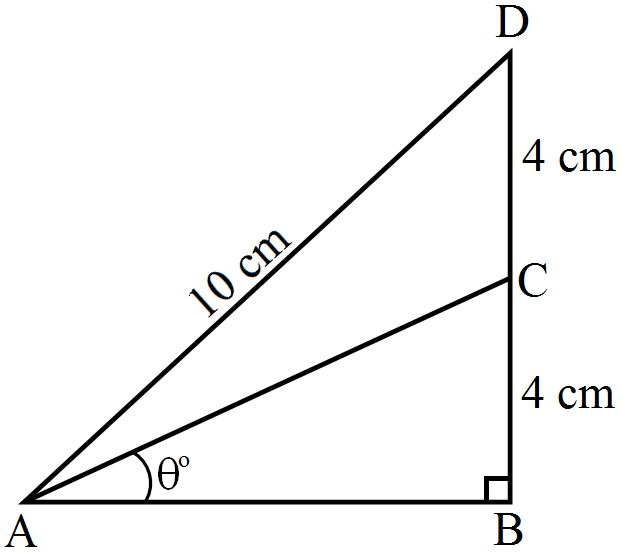
In the adjoining figure, $\angle\text{B}=90^\circ,\angle\text{BAC}=\theta,\text{BC}=\text{CD}=4\text{cm}$ and AD = 10cm. Find
  1. $\sin\theta$
  2. $\cos\theta.$
Hint: $\text{AB}^2=\big(\text{AD}^2-\text{BD}^2\big)=36\text{cm}^2$ $\therefore\text{AB}=6\text{cm}.$ $\text{AC}^2=\big(\text{AB}^2+\text{BC}^2\big)=52\text{cm}^2$ $\therefore\text{AC}=2\sqrt{13}\text{cm}.$ Thus, AB = 6cm and $\text{AC}=2\sqrt{13}\text{cm}.$
Sum of the areas of two squares is $640\ m^2$. If the difference of their perimeters is $64\ m$ . Find the sides of the two squares.
An express train takes $1$ hour less than a passenger train to travel $132\ km$ between Mysore and Bangalore (without taking into consideration the time they stop at intermediate stations). If the average speed of the express train is $11\ km/hr$ more than that of the passenger train, find the average speed of two trains.