Question

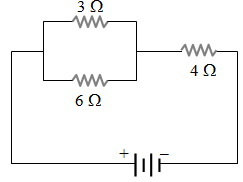
In the given figure, when galvanometer shows no deflection, the current (in ampere) flowing through 5Ω  resistance will be

(a) 0.5

(b) 0.6

(c) 0.9

(d) 1.5

Answer

(b) 0.6

Need a full question paper?

Generate a complete, print-ready paper with questions like this in minutes — across 16+ boards, with answer keys.

Start Generating Free

Similar questions

Two capacitors of capacitance 2 μF and 3μF  are joined in series. Outer plate first capacitor is at 1000 volt and outer plate of second capacitor is earthed (grounded). Now the potential on inner plate of each capacitor will be

(a) 700 Volt

(b) 200 Volt

(c) 600 Volt

(d) 400 Volt

In the adjoining circuit, the e.m.f. of the cell is 2 volt and the internal resistance is negligible. The resistance of the voltmeter is 80 ohm. The reading of the voltmeter will be

(a) 0.80 volt

(b) 1.60 volt

(c) 1.33 volt

(d) 2.00 volt

In the figure, current through the 3 Ω  resistor is 0.8 ampere, then potential drop through 4 Ω  resistor is

(a) 9.6 V

(b) 2.6 V

(c) 4.8 V  

(d) 1.2 V

Magnetic moment of a small bar magnet is $1.2 A- m ^2$. Magnetisation field at a distance of 0.1 m on its axis is :
Using visible light what is the shortest wavelength which can be measured?

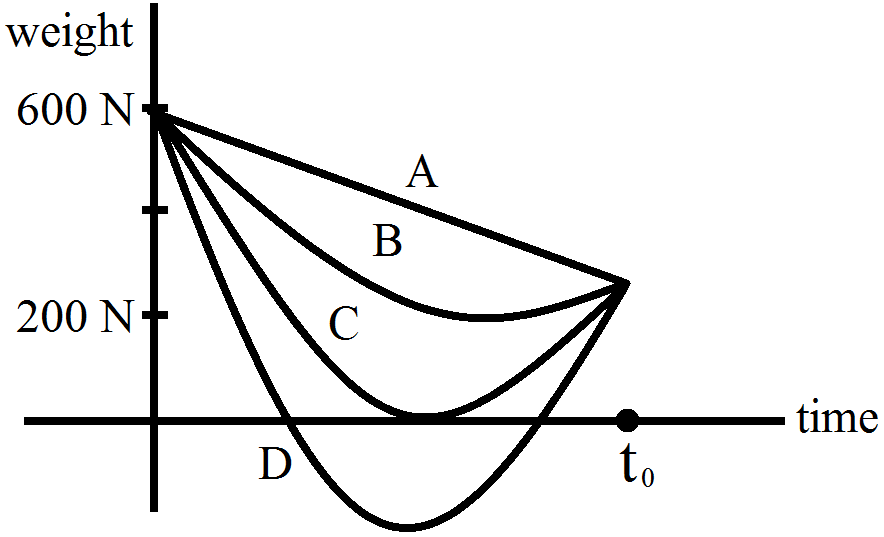
Suppose, the acceleration due to gravity at the earth's surface is 10ms-2 and at the surface of Mars it is 4⋅0ms-2. A 60kg passenger goes from the earth to the Mars in a spaceship moving with a constant velocity. Neglect all other objects in the sky. Which part of best represents the weight (net gravitational force) of the passenger as a function of time?

  1. A
  2. B
  3. C
  4. D

If a steady current of 4 amp maintained for 40 minutes, deposits 4.5 gm of zinc at the cathode and then the electro chemical equivalent will be

(a) 51  

(b) 28 

(c) 32  

(d) 47  

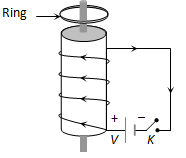
A conducting ring is placed around the core of an electromagnet as shown in fig. When key K is pressed, the ring

(a) Remain stationary

(b) Is attracted towards the electromagnet

(c) Jumps out of the core

(d) None of the above

What is the dielectric constant of a metal?
Which of the following is not a consequence of Gauss’s law?