Question

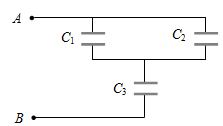
In the given network capacitance,  and . What is the resultant capacitance between A and B

(a) 2.2 μF

(b) 3.2 μF

(c) 1.2 μF   

(d) 4.7 μF

Answer

(b) 3.2 μF

Need a full question paper?

Generate a complete, print-ready paper with questions like this in minutes — across 16+ boards, with answer keys.

Start Generating Free

Similar questions

The current in a coil decreases from 1 A to 0.2 A. In 10sec. Calculate the coefficient of self inductance. If induced emf is 0.4 volt.

(a) 5 H

(b)  3 H

(c)  4 H

(d) 2 H

The focal lengths of the objective and eye lens of a microscope are 4 cm and 8 cm respectively, and the distance of the object from the eye lens is 4.5 cm ., then the magnifying power will be :

A parallel plate capacitor has circular plates of 0.08m  radius and 1.0   separation. If a P.D. of 100 volt is applied, the charge will be

(a) 1.8  

(b) 1.8  

(c) 1.8  

(d) None of these

There will be no force between two wires carrying currents if currents are:
When a glass rod is rubbed with silk, what kind of charge will be developed on glass?
Which of the following is not a valid reason for using alloys to make standard resistors?

A neon sign does not produce

(a) Line spectrum

(b) An emission spectrum

(c) An absorption spectrum

(d) Photons

An electric field $\overrightarrow{\text{E}}$ and a magnetic field $\overrightarrow{\text{B}}$ exist in a region. The fields are not perpendicular to each other.
  1. This is not possible.
  2. No electromagnetic wave is passing through the region.
  3. An electromagnetic wave may be passing through the region.
  4. An electromagnetic wave is certainly passing through the region.

When the electron in the hydrogen atom jumps from 2nd orbit to 1st orbit, the wavelength of radiation emitted is 𝜆. When the electrons jump from 3rd orbit to 1st orbit, the wavelength of emitted radiation would be

(a)  

(b)

(c)

(d)

A photon and an electron have equal energy E.  is proportional to

(a)  

(b) 1/ 

(c) 1/E     

(d) Does not depend upon E