MCQ
In the given pair identify most acidic compound in $(A)$ and $(B)$. Most basic in $(C)$ and $(D)$.
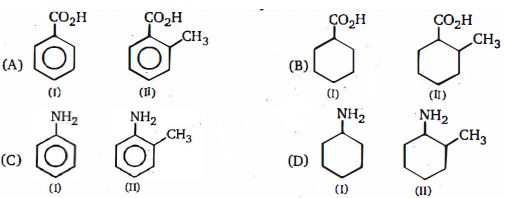
- A$A - I, B - II, C - I, D - II$
- ✓$A - II, B - I, C - I, D - II$
- C$A - II, B - II, C - II, D - II$
- D$A - I, B - II, C - I, D - I$
$2,6 - di - Me (pK_a \,3.21) > 2 - t - Bu \,(pK_a \,3.46) > 2 - Me \,(pK_a\, 3.91)$.
Here again, if we consider the stability of the anion, steric inhibition of resonance prevents the $+ R$ effect of the ring coming into operation (see above), and since this weakens acid strength, its absence results in increased acid strength.
For options $B$ and $D$, no ortho effect is valid and order of acidity and basicity is calculated by nearly examining the inductive effect.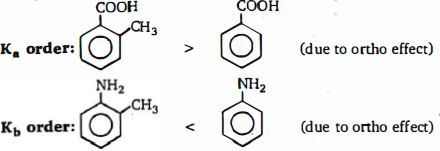
Generate a complete, print-ready paper with questions like this in minutes — across 16+ boards, with answer keys.

$\ln {k_t} = \ln {k_0} + \left( {\frac{{\ln \left( {\frac{5}{2}} \right)}}{{10}}} \right) \times t\left( {t \geqslant 0{}\,^0C} \right)$
$K_0$ =rate constant at $0\,^o C$ ; $k_t$ = rate constant at $t\,^o C$
Temperature coefficient of reaction, assuming that the rate constant increases same number of times on each $10\,^oC$ rise in temperature, is