Question
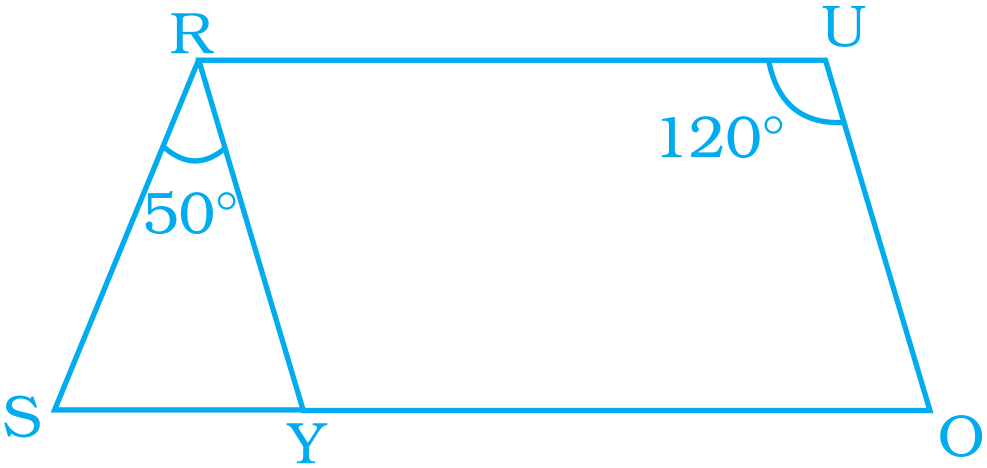
In the given parallelogram $YOUR$, $\angle\text{RUO}=120^\circ\text{and}\ \text{OY}$ is extended to point $S$ such that $\angle\text{SRY}=50^\circ.\text{Find}\angle\text{YSR}.$
Answer

Given, $\angle\text{RUO}=120^\circ\ \text{and}\ \angle\text{SRY}=50^\circ$
$\angle\text{RYO}=\angle\text{SYR}=180^\circ-\text{RYO}$
Now, $\angle\text{SYR}=180^\circ-\angle\text{RYO}$
$=180^\circ-120^\circ=60^\circ$
$\text{In}\triangle\text{SRY},$
By the angle sum property of a triangle, $\angle\text{SYR}+\angle\text{RYS}+\angle\text{YSR}=180^\circ$
$\Rightarrow50^\circ+60^\circ+\angle\text{YSR}=180^\circ$
$\Rightarrow\angle\text{YSR}=180^\circ-(50^\circ+60^\circ)=70^\circ.$

Need a full question paper?

Generate a complete, print-ready paper with questions like this in minutes — across 16+ boards, with answer keys.

Start Generating Free

Similar questions

Compute the amount and the compound interest in each of the following by using the formulae when:
Principal $= Rs. 3000,$ Rate $= 18\%,$ Time $= 2$ years
If a box of sweets is divided among 24 children, they will get 5 sweets each. How many would each get, if the number of the children is reduced by 4 ?
In a repeater machine with $0$ as an exponent, the base machine is applied $0$ times.
$a.$ What do these machines do to a piece of chalk?

$b.$ What do you think the value of $60$ is? You have seen that a hookup of repeater machines with the same base can be replaced by a single repeater machine. Similarly, when you multiply exponential expressions with the same base, you can replace them with a single expression.
Find the square root of the following correct to three places of decimal:$0.1$
Multiply the following: $(2x - 2y - 3), (x + y + 5)$
Simplify: $\frac{\sqrt{0.2304}\ +\sqrt{0.1764}}{\sqrt{0.2304}\ -\sqrt{0.1764}}$
Find the amount of $Rs. 12500$ for $2$ years compounded annually, the rate of interest being $15\%$ for the first year and $16\%$ for the second year.
Subtract the following
(i) $3 \text{t}^4-4 \text{t}^3+2 \text{t}^2-6 \text{t}+6$ from $-4 \text{t}^4+8 \text{t}^3-4 \text{t}^2-2 \text{t}+11$
(ii) $2 \text{a} \text{b}+5 \text{b} \text{c}-7 \text{a} \text{c}$ from $5 \text{a} \text{b}-2 \text{a} \text{c}+10 \text{a} \text{b} \text{c}$
Factorise: $a^4-2 a^2 b^2+b^4$
What must be added to following expressions to make it a whole square?
$4x^2- 12x + 7$