MCQ
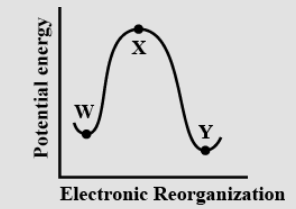
In the given potential energy diagram, the point $X$ represents :
  • A transition state
  • B
    A reaction intermediate
  • C
    A resonance hybrid
  • D
    A reactant

Answer

Correct option: A.
A transition state
In the given potential energy diagram, the point $\text{XX}$ represents the transition state.
It is the maximum energy state and below which reaction will not occur.

Need a full question paper?

Generate a complete, print-ready paper with questions like this in minutes — across 16+ boards, with answer keys.

Start Generating Free

Similar questions

Which of the following is the industrial method of preparation of $\ce{H_2O_2}?$
One mole of a symmetrical alkene on ozonolysis gives two moles of an aldehyde having a molecular mass of $44\, u.$ The alkene is
For the reaction

$H _{2} F _{2( g )} \rightarrow H _{2( g )}+ F _{2( g )}$

$\Delta U =-59.6\,kJ\,mol ^{-1} \text { at } 27^{\circ}\,C$.

The enthalpy change for the above reaction is (-) $kJ mol ^{-1}$ [nearest integer] Given : $R =8.314\,JK ^{-1}\,mol ^{-1}$

${C_{{\rm({daimond})}}}$ $+$ ${O_2} \to C{O_2};$ $\Delta H = - 395.3\,kJ/mole$

${C_({graphite)}} + {O_2} \to C{O_2};\,\Delta H = - 393.4\,kJ/mole$

${C_({graphite})} \to {C_{{\rm({diamond})}}};\,\Delta H = $

The bond dissociation energy of $B-F$ in $BF_3$ is $646\,kJ\,mol^{-1}$ whereas that of $C-F$ in $CF_4$ is $515\,kJ\,mol^{-1}$ . The correct reason for higher $B-F$ bond dissociation energy as compared to that of $C-F$ is
The oxidation number of $Cr$ in ${K_2}C{r_2}{O_7}$ is
The electronic configuration of four elements are given in brackets$L\,\left( {1{s^2},\,\,2{s^2}2{p^1}} \right);\,\,M\,\left( {1{s^2},\,\,2{s^2}\,2{p^5}} \right)$

$Q\,\left( {1{s^2},\,\,2{s^2}\,2{p^6},\,\,3{s^1}} \right);\,\,R\,\left( {1{s^2},\,\,2{s^2}\,2{p^2}} \right)$The element that would most readily form a diatomic molecule is

Hydrogen bonding plays a central role in the following phenomena :

$(A)$ Ice floats in water.

$(B)$ Higher Lewis basicity of primary amines than tertiary amines in aqueous solutions.

$(C)$ Formic acid is more acidic than acetic acid.

$(D)$ Dimerisation of acetic acid in benzene.

Millimoles of calcium hydroxyide required to produce $100\,mL$ of the aqueous solution of $pH \,12$ is $x \times 10^{-1}$. The value of $x$ is $..............$. (Nearest integer).Assume complete dissociation.
$C{H_2} = C{H_2}\xrightarrow{{B{r_2}/{H_2}O}}A,$ In the above reaction the compound $A$ is