MCQ
In the given reaction,
CH2 = CH2(g) + H2(g) → CH3—CH3(g)
ethene undergoes:
CH2 = CH2(g) + H2(g) → CH3—CH3(g)
ethene undergoes:
- AReduction process.
- BOxidation process.
- CAddition process.
- DAll of these.
Explanation:
CH2=CH2 + H—H → H3C—CH3
(Addition of hydrogen)
Because of the addition of hydrogen, there occurs reduction of ethylene.
Generate a complete, print-ready paper with questions like this in minutes — across 16+ boards, with answer keys.
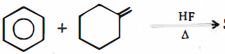
Major product $(A)$ of the above reaction
if $T_1 < T_2$ then $X$ and $Y$ respectively are
Product $'C'$ is
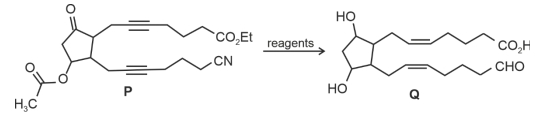
$(A) i)$ Lindlar's catalyst, $H _2$; $ii$) $SnCl _2 / HCl$; iii) $NaBH _4$; iv) $H _3 O ^{+}$
$(B) i)$ Lindlar's catalyst, $H _2$; $ii$) $H _3 O ^{+}; iii)$ $SnCl _2 / HCl$; iv) $NaBH _4$
$(C) i)$ $NaBH _4; ii)$ $SnCl _2 / HCl; $iii$)$ $H _3 O ^{+}; iv)$ Lindlar's catalyst, $H _2$
$(D) i)$ Lindlar's catalyst, $H _2$; $ii$) $NaBH _4; iii)$ $SnCl _2 / HCl; iv)$ $H _3 O ^{+}$