MCQ
In the Kjeldahl's method for estimation of nitrogen present in a soil sample, ammonia evolved from $0.75\, g$ of sample neutralized $10\, mL$ of $1\, M \,H_2SO_4.$ The percentage of nitrogen in the soil is
- ✓$37.33$
- B$45.33$
- C$35.33$
- D$43.33$
$10\, \mathrm{m} \,\mathrm{mol} \,\mathrm{H}_{2} \mathrm{SO}_{4}=20\, \mathrm{m}\, \mathrm{mol}$ of $\mathrm{NH}_{3}$
$\left[\mathrm{H}_{2} \mathrm{SO}_{4}+2 \mathrm{NH}_{3} \longrightarrow\left(\mathrm{NH}_{4}\right)_{2} \mathrm{SO}_{4}\right]$
$1\, \mathrm{mol}\; \mathrm{NH}_{3}$ contains $14 \,\mathrm{g}$ nitrogen $20 \times 10^{-3}\, \mathrm{mol}\; \mathrm{NH}_{3}$ contains $14 \times 20 \times 10^{-3}$ nitrogen
$0.75\, \mathrm{g}$ of sample contains
$\%$ Nitrogen $=\frac{14 \times 20 \times 10^{-3}}{0.75} \times 100=37.33 \%$
Generate a complete, print-ready paper with questions like this in minutes — across 16+ boards, with answer keys.
Statement $I$ : The rate law for the reaction $A+B \rightarrow C$ is rate $(r)=k[A]^2[B]$. When the concentration of both $\mathrm{A}$ and $\mathrm{B}$ is doubled, the reaction rate is increased " $\mathrm{x}$ " times.
Statement $II$ :
(Image)
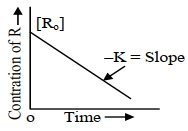
The figure is showing "the variation in concentration against time plot" for a $"y"$ order reaction. The value of $x+y$ is . . . . . .