MCQ
In the main group elements $(i)$ as we proceed down the same group in the periodic table and $(ii)$ as we proceed from left to right in the same period, the atomic radius
  • $(i)$ Increase continuously; $(ii)$ Decreases continuously
  • B
    $(i)$ Decreases continuously; $(ii)$ Increases continuously
  • C
    $(i)$ Increases continuously; $(ii)$ Decreases upto the group $IV$ and then increases upto the end of the period.
  • D
    $(i)$ Decreases continuously; $(ii)$ Decreases upto the group $IV$ and then increases upto the end of the period.

Answer

Correct option: A.
$(i)$ Increase continuously; $(ii)$ Decreases continuously
a
Down the group atomic radius increases and in a period from left to right atomic radius decreases.

Need a full question paper?

Generate a complete, print-ready paper with questions like this in minutes — across 16+ boards, with answer keys.

Start Generating Free

Similar questions

$\begin{array}{*{20}{c}}
  {C{H_2} - C{O_2}K} \\ 
  {|\,\,\,\,\,\,\,\,\,\,\,\,\,\,\,\,\,\,\,\,\,\,\,\,\,\,} \\ 
  {C{H_2} - C{O_2}K} 
\end{array}\xrightarrow{{electrolysis}}\mathop {(A)}\limits_{\left( {major} \right)} $ (Kolbe electrolysis method)

Product $(A)$ of the reaction is 

Assign true $(T)$ or false $(F)$ for following statements and select correct option for your answer 

$(I)$ $I.P.$ of $O(g)$ is less than $I.P.$ of  $O_{\left( g \right)}^ - $

$(II)$ $I.P.$ of $Ne(g)$ is greater than $I.P$. of $Ne_{\left( g \right)}^ + $

$(III)$ $E.A.$ of $O_{\left( g \right)}^ + $ is greater than $E.A.$ of $O(g)$

$(IV)$ $I.P.$ of $N(g)$ is greater than $I.P.$ of $N_{\left( g \right)}^ + $

$x =$ moles of $KOH$ consumed is
The reaction of (figure) with $HBr$ gives
The common features among the species $C{N^ - }$, $CO$ and $N{O^ + }$ are
Which alcohol give instant turbidity with Lucas reagent
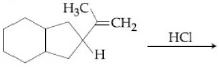
The major product of the following reaction is
Rutherford's scattering experiment is related to the size of the
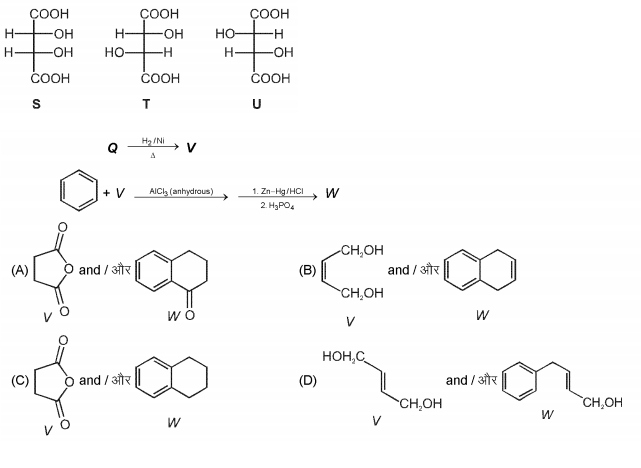
$P$ and $Q$ are isomers of dicarboxylic acid $C _4 H _4 O _4$. Both decolorize $Br _2 / H _2 O$. On heating, $P$ forms the cyclic anhydride.

Upon treatment with dilute alkaline $KMnO _4, P$ as well as $Q$ could produce one or more than one from $S , T$ and $U$.$Image$

$1.$ Compounds formed form $P$ and $Q$ are, respectively

$(A)$ Optically active $S$ and optically active pair $(T, U)$

$(B)$ Optically inactive $S$ and optically inactive pair $(T, U)$

$(C)$ Optically active pair $(T, U)$ and optically active $S$

$(D)$ Optically inactive pair $(T, U)$ and optically inactive $S$

$2.$ In the following reaction sequences $V$ and $W$ are respectively :$Image$

mcq $Image$

Give the answer question $1$ and $2.$

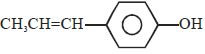
Which of the following compounds will exhibit geometrical isomerism