MCQ
In the modern periodic table, elements are arranged in
- AIncreasing mass
- BIncreasing volume
- ✓Increasing atomic number
- DAlphabetically
Generate a complete, print-ready paper with questions like this in minutes — across 16+ boards, with answer keys.
Scheme $1$ : (image)
Scheme $2$ :(image)
Scheme $3$ :(image)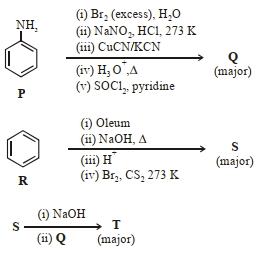
$\mathrm{V}^{2+}(\mathrm{aq})+2 \mathrm{e}^{-} \rightarrow \mathrm{V} \ \ \ \ \mathrm{E}^0=-1.19 \mathrm{~V} $
$\mathrm{Fe}^{3+}(\mathrm{aq})+3 \mathrm{e}^{-} \rightarrow \mathrm{Fe} \ \ \ \ \mathrm{E}^0=-0.04 \mathrm{~V} $
$\mathrm{Au}^{3+}(\mathrm{aq})+3 \mathrm{e}^{-} \rightarrow \mathrm{Au} \ \ \ \ \mathrm{E}^0=+1.40 \mathrm{~V} $
$\mathrm{Hg}^{2+}(\mathrm{aq})+2 \mathrm{e}^{-} \rightarrow \mathrm{Hg} \ \ \ \ \mathrm{E}^0=+0.86 \mathrm{~V}$
The pair$(s)$ of metals that is$(are)$ oxidized by $\mathrm{NO}_3^{-}$in aqueous solution is$(are)$
$(A)$ $\mathrm{V}$ and $\mathrm{Hg}$ $(B)$ $\mathrm{Hg}$ and $\mathrm{Fe}$
$(C)$ $\mathrm{Fe}$ and $\mathrm{Au}$ $(D)$ $Fe$ and $V$
$\begin{array}{*{20}{c}}
{C{H_3} - CH - CH - C{H_2} - COOH} \\
{|\,\,\,\,\,\,\,\,\,\,\,\,\,|\,\,\,\,\,\,\,\,\,\,\,\,\,\,\,\,\,\,\,\,\,\,\,\,\,\,} \\
{\,\,OH\,\,\,\,\,\,\,\,Cl\,\,\,\,\,\,\,\,\,\,\,\,\,\,\,\,\,\,\,\,\,\,\,\,\,\,\,\,\,}
\end{array}$
For this reaction which statement is false
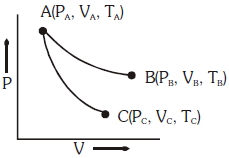
$AB \to$ Isothermal expansion
$AC \to$ Adiabatic expansion
Which of the following options is not correct ?