Question
In the nuclear reaction  is
is
|
(a) |
(b) |
(c) |
(d) |
In the nuclear reaction is
|
(a) |
(b) |
(c) |
(d) |
(c) 
Generate a complete, print-ready paper with questions like this in minutes — across 16+ boards, with answer keys.
AM is used for broadcasting because
|
(a) It is more noise immune than other modulation systems |
|
(b) It requires less transmitting power compared with other systems |
|
(c) Its use avoids receiver complexity |
|
(d) No other modulation system can provide the necessary bandwidth faithful transmission |
The current in the adjoining circuit will be
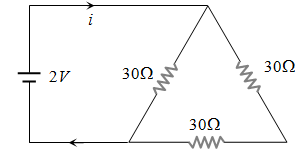
|
(a) |
(b) |
(c) |
(d) |
A thin lens focal length  and its aperture has diameter d. It forms an image of intensity I. Now the central part of the aperture upto diameter
  is blocked by an opaque paper. The focal length and image intensity will change to
|
(a) |
(b) f and |
(c) |
(d) f and |
A diverging beam of light from a point source S having divergence angle a, falls symmetrically on a glass slab as shown. The angles of incidence of the two extreme rays are equal. If the thickness of the glass slab is t and the refractive index n, then the divergence angle of the emergent beam is
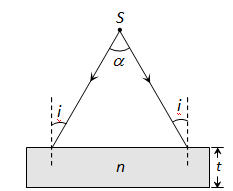
|
(a) Zero |
(b) α |
(c) |
(d) 2 |
The diagram shows-the energy levels for an electron in a certain atom. Which transition shown represents the emission of a photon with the most energy
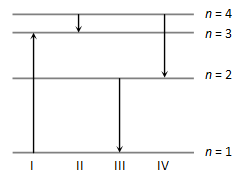
| (a) I | (b) II | (c) III | (d) IV |
The effective resistance between points A and B is

|
(a) 10 Ω |
(b) 20 Ω |
|
(c) 40 Ω |
(d) None of the above three values |
When light wave suffers reflection at the interface from air to glass, the change in phase of the reflected wave is equal to
| (a) 0 |
(b) 
|
(c) 
|
(d) 2
|


