MCQ
In the reaction $3Mg + {N_2} \to M{g_3}{N_2}$
  • A
    Magnesium is reduced
  • Magnesium is oxidized
  • C
    Nitrogen is oxidized
  • D
    None of these

Answer

Correct option: B.
Magnesium is oxidized
(b) In the given reaction oxidation state of $Mg$ is changing from $0$ to $+2$ while in nitrogen it is changing from $0$ to $-3$. So oxidation of $Mg$ and reduction of nitrogen takes place.

Need a full question paper?

Generate a complete, print-ready paper with questions like this in minutes — across 16+ boards, with answer keys.

Start Generating Free

Similar questions

In the following reaction, $X$ is..

$X\xrightarrow{{{\text{Bromination}}}}Y\xrightarrow{{NaN{O_2} + HCl}}Z\mathop {\xrightarrow{{{\text{Boiling}}}}}\limits_{{C_2}{H_5}OH} {\text{Tribromobenzene}}$
For the reaction $4NH_3 + 5O_2 \to 4NO + 6H_2O$ , if the rate of disappearance of $NH_3$ is $3.6 \times 10^{-3}\, mol\, L^{-1}\,s^{-1}$ , what is the rate of formation of $H_2O$ ?
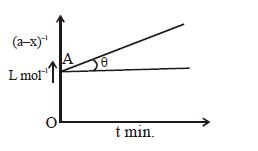
Following is the graph between $(a-x)^{-1}$ and time $t$ for second order reaction if $\theta  = {\tan ^{ - 1}}\left( {\frac{1}{2}} \right)$ ; $OA = 2\,L\,mol^{-1}$ then rate at the start of reation will be $ [$ in $L\, mol^{-1}\,min^{-1}]$
The pair of amphoteric hydroxides is
The reaction between $X$ and $Y$ is first order with respect to $X$ and zero order with respect to $Y$.

Experiment $\frac{[ X ]}{ mol \;L ^{-1}}$ $\frac{[ Y ]}{ mol\; L ^{-1}}$ $\frac{\text { Initial rate }}{ mol\; L ^{-1}\; min ^{-1}}$
$I$ $0.1$ $0.1$ $2 \times 10^{-3}$
$II$ $0.2$ $0.2$ $4 \times 10^{-3}$
$III$ $0.4$ $0.4$ $M \times 10^{-3}$
$IV$ $0.1$ $0.2$ $2 \times 10^{-3}$

Examine the data of table and calculate ratio of numerical value of $M$

The ground state term symbol for an electronic state is governed by
In acid medium nitrobenzene is reduced to aniline as shown in the reaction

${C_6}{H_5} - N{O_2} + 6[H] \to {C_6}{H_5} - N{H_2} + 2{H_2}O$

The reducing agent used in this reaction is …….
Predict the correct order among the following :
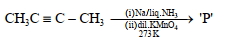
The major product of the following reaction is $P$. Number of oxygen atoms present in product ' $\mathrm{P}$ ' is  . . . . . . . . . .(nearest integer).
${\text{C}}{{\text{H}}_3}{\text{C}}{{\text{H}}_2}{\text{COOH}}\xrightarrow[{{\text{Red P}}}]{{{\text{B}}{{\text{r}}_2}}}X\xrightarrow[\Delta ]{{{\text{Alc}}{\text{.KOH}}}}Y$ 

$Y$  in the above reaction is