MCQ
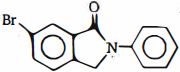
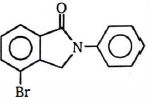
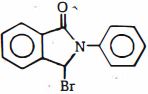
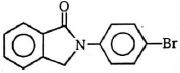
In the reaction given below, the major product formed is
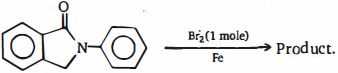
  • A

  • B

  • C


Answer

Correct option: D.

d
$(d)$ More activated ring undergo electrophilic aromatic substitution.

Need a full question paper?

Generate a complete, print-ready paper with questions like this in minutes — across 16+ boards, with answer keys.

Start Generating Free

Similar questions

In which of the following molecule is the covalent bond most polar
Species isoelectronic with $BF_3$ would be
The wavelength of a spectral line for an electronic transition is inversely related to :
The reaction $A + B\xrightarrow{k}$ product is first order with respect to $A$ and zero order with respect to $B$. If $b_0$ and $b_t$ are the concentration of $B$ at $t = 0$ and after time $t\, sec$ respectively the select the correct relationship -
An organic compound containing carbon hydrogen and oxygen contains $52.20\%$ carbon and $13.04\%$ hydrogen. Vapour density of the compound is $23$. Its molecular formula will be
$\Delta {S_{{\rm{Total}}}} =  - 40\ kJ/mol-K$

$\Delta {H_{{\rm{System}}}} = 2000\ kJ/mol$

$T = 400\ K$

Find out value of $\Delta {S_{{\rm{System}}}}$..........$ kJ/mol-K$

If the reduction potential is more, then
Which electronic level would allow the hydrogen atom to absorb a photon but not to emit a photon
Which of following is/are correct ?

$(A)$ Nucleotide form from nucleoside and phosphate group by ether linkage

$(B)$ In nucleoside, nitrogenous base link with hexose sugar of $DNA$ or $RNA$

$(C)$ $DNA$ and $RNA$ are differ in only nature of sugar

$(D)$ $A = T$ and $C \equiv G$ are hydrogen bond between nitrogenous base

Find the value of enthaly of formation of $PCl_5 \,:$ Given

$\frac{1}{2}\,{P_4}(s)\,\, + \,\,3C{l_2}(g)\, \to \,2PC{l_3}(\ell )\,\,\,\,\,\Delta H\, = \, - \,635\,\,kJ$

$PCl_3 (\ell )\,+\,Cl_2(g)\,\to \,PCl_5(s) \,\,\,\,\Delta H\, =\, -\,137\,kJ$.....$kJ$