MCQ
In the reaction :$I_2 + 2S_2O_3^{2-} \to 2I^- + S_4O_6^{2-}$
  • A
    $I_2$ is reducing agent.
  • $I_2$ is oxidising agent and $S_2O_3^{2-}$ is reducing agent.
  • C
    $S_2O_3^{2-}$ is oxidising agent.
  • D
    $I_2$ is reducing agent and $S_2O_3^{2-}$ is oxidising agent.
Answer

Correct option: B.
$I_2$ is oxidising agent and $S_2O_3^{2-}$ is reducing agent.
b
$\stackrel{0}{I}_2 \rightarrow \stackrel{0^{-}}{2I}$

$I _2$ undergoes reduction hence acts as oxidising agents.

$S _2^{+2} O _6^{2-} \rightarrow S _4^{+2.5} O _6^{2-}$

It undergoes oxidation hence acts as a reducing agent.

Need a full question paper?

Generate a complete, print-ready paper with questions like this in minutes — across 16+ boards, with answer keys.

Start Generating Free

Similar questions

Given 

$(I)$ ${H_2}(g) + \frac{1}{2}{O_2}(g) \to {H_2}O(l);$

$\Delta {H^o_{298\,K}} =  - 285.9\,kJ\,mo{l^{ - 1}}$

$(II)$ ${H_2}(g) + \frac{1}{2}{O_2}(g) \to {H_2}O(g);$

$\Delta {H^o_{298\,K}} =  - 241.8\,kJ\,mo{l^{ - 1}}$

The molar enthalpy of vapourisation of water will be.....$kJ\,mol^{-1}$

Combustion of glucose takes place according to the equation, ${C_6}{H_{12}}{O_6} + 6{O_2} \to 6C{O_2} + 6{H_2}O$,$\Delta H = - 72\,kcal$. How much energy will be required for the production of $1.6 \,g$  of glucose......$kcal$. (Molecular mass of glucose $= 180 \,g$)
“The quantity of heat which must be supplied to decompose a compound into its element is equal to the heat evolved during the formation of that compound from the elements.” This statement is known as
Number of benzene derivatives of $C_7H_7Cl$ is :
Which one of the following is most stable ?
The statement that is not correct for periodic classification of elements is:
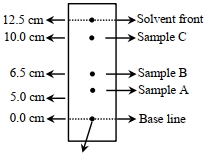
Using the given figure, the ratio of $R_t$ values of sample $A$ and sample $\mathrm{C}$ is $\mathrm{x} \times 10^{-2}$. Value of $\mathrm{x}$ is . . . . . . . . 

(Image)

Samples $(A, B, C)$

Fig : Paper chromatography of Samples

The oxidation number of carbon in $C{H_2}O$ is
${C{H_3} - C{H_2} - C{H_2} - C{H_3}\xrightarrow[\Delta ]{{AlC{l_3}}}}$ $\begin{array}{*{20}{c}}
  {C{H_3} - CH - C{H_3}} \\ 
  {|\,\,\,\,} \\ 
  {\,\,C{H_3}} 
\end{array}$

Above reaction is an example of

For the Balmer series in the spectrum of $\mathrm{H}$ atom, $\quad \bar{v}=R_{H}\left\{\frac{1}{n_{1}^{2}}-\frac{1}{n_{2}^{2}}\right\}, \quad$ the correct statements among $(I)$ to $(IV)$ are

$(I)$ As wavelength decreases, the lines in the series converge

$(II)$ The integer $n_{1}$ is equal to $2$

$(III)$ The lines of longest wavelength corresponds to $\mathrm{n}_{2}=3$

$(IV)$ The ionization energy of hydrogen can be calculated from wave number of these lines