MCQ
In the reaction $Image$ the intermediate$(s)$ is(are)
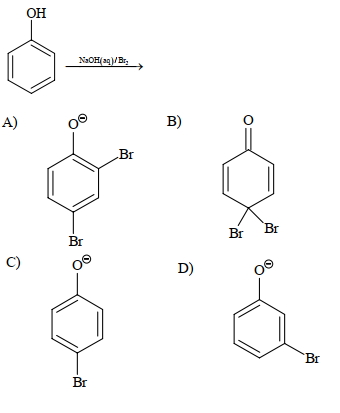
- ✓$(A,B,C)$
- B$(A,B,D)$
- C$(B,C,D)$
- D$(B,A,C)$
$Image$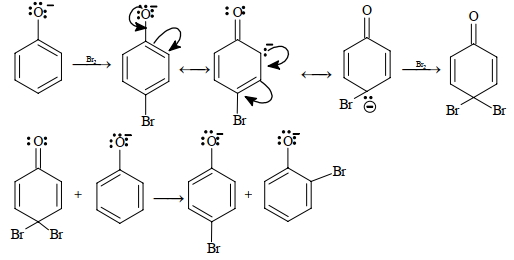
Generate a complete, print-ready paper with questions like this in minutes — across 16+ boards, with answer keys.
The time taken for $A$ to become $1 / 4^{\text {th }}$ of its inital concentration is twice the time taken to become $1 / 2$ of the same. Also, when the change of concentration of $B$ is plotted against time, the resulting graph gives a straight line with a negative slope and a positive intercept on the concentration axis. The overall order of the reaction is . . . . .
$2$. $XeF_2 \xrightarrow{H_2O} $
$3$. $XeF_4 \xrightarrow{H_2O} $
$4$. $PbO_2 \xrightarrow{\Delta } $
$5$. $XeF_6 \xrightarrow{H_2O} $
In how many of the above processes, $O_2$ will be one of the products
$(A)\,\, HCHO$ $(B) \,\,CH_3COCH_3$
$(C)\,\,PhCOCH_3$ $(D)\,\ PhCOPh$