Question
In the relation $\text{p}=\Big(\frac{\text{a}}{\text{b}}\Big)^{\text{e}^{-\Big(\frac{\text{az}}{\theta}\Big)}},\text{p}$ is the pressure, Z is the distance, and is the temperature. What is the dimensional formula of p?

Answer

Since, ${\text{e}^{-\Big(\frac{\text{aZ}}{\theta}\Big)}}$is dimensionless, We have $\frac{\text{aZ}}{\theta}=1$ Or $\text{a}=\frac{\theta}{\text{Z}}=\frac{\text{K}}{\text{L}}=[\text{L}^{-1}\text{K}]$ We find that $\frac{\text{a}}{\text{b}}=$ dimensions of p and $\text{b} = [\text{ML}^{-1}\text{T}^{-2}].$ Therefore, dimensional formula of p is obtained as $\text{p}=\frac{\text{a}}{[\text{ML}^{-1}\text{T}^{-2}]}=\frac{[\text{L}^{-1}\text{K}]}{[\text{ML}^{-1}\text{T}^{-2}]}$ $=[​​\text{M}^{-1}\text{L}^0\text{T}^2\text{K}]$

Need a full question paper?

Generate a complete, print-ready paper with questions like this in minutes — across 16+ boards, with answer keys.
Start Generating Free

Similar questions

Plot the corresponding reference circle for each of the following simple harmonic motions. Indicate the initial (t = 0) position of the particle, the radius of the circle, and the angular speed of the rotating particle. For simplicity, the sense of rotation may be fixed to be anticlockwise in every case: (x is in cm and t is in s).$\text{x}=\cos\Big(\frac{\pi}{6}-\text{t}\Big)$
Express the average distance of earth from the sun in:
  1. Light year.
  2. Par sec.
A parallel-plate capacitor with plate area $20cm^2$ and plate separation 1.0mm is connected to a battery. The resistance of the circuit is $10\text{k}\Omega.$ Find the time constant of the circuit.
A ball bounces to $80\%$ of its original height. What fraction of its mechanical energy is lost in each bounce?
A wheel starting from rest is uniformly accelerated at $4 ~rad/-s^2$ for 10 seconds.It is allowed to rotate uniformly for the next 10 seconds and is finally brought to rest in the next 10 seconds. Find the total angle rotated by the wheel.
A particle is performing simple harmonic motion along x-axis with amplitude 4.0cm and time period 1.2s. What is the minimum time taken by the particle to move from x = +2cm to x = +4cm and back again?
If the separation between the slits in a Young's double slit experiment is increased, what happens to the fringe-width? If the separation is increased too much, will the fringe pattern remain detectable?
A man of mass $70kg$ stands on a weighing scale in a lift which is moving. Downwards with a uniform acceleration of $5ms^{-2}$.
A square coil of edge l and with n turns carries a current i. It is kept on a smooth horizontal plate. A uniform magnetic field B exists parallel to an edge. The total mass of the coil is M. What should be the minimum value of B for which the coil will start tipping over?
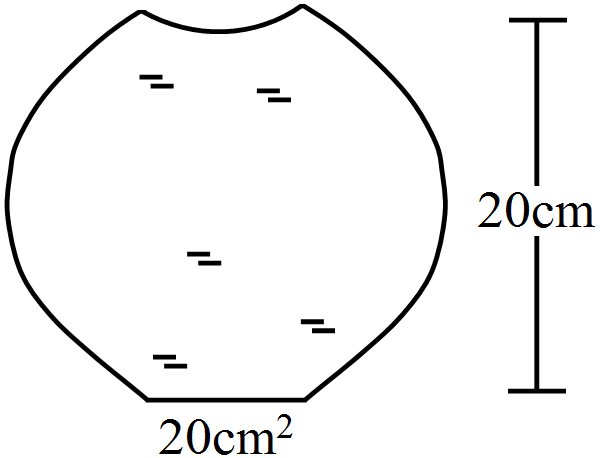
A glass full of water has a bottom of area $20\ cm^2$, top of area $20\ cm^2$, height $20\ cm$ and volume half a litre.
  1. Find the force exerted by the water on the bottom.
  2. Considering the equilibrium of the water, find the.
Resultant force exerted by the sides of the glass on the water. Atmospheric pressure $= 1.0 \times 10^5N/m^2$. Density of water $= 1000\ kg/m^3$ and $g = 10m/s^2$. Take all numbers to be exact.​​​​​​​